

Beef Tallow for Eczema: Does It Really Work? Evidence Reviewed
Reader-supportedHonest look at beef tallow for eczema. Filaggrin, barrier dysfunction, what the research says, application protocol, what to avoid, and when to see a derm.

This post contains affiliate links. We may earn a commission if you purchase through these links, at no extra cost to you.
Medical disclaimer: I am not a doctor. This post is a layperson’s review of the research and my own experience. Eczema (atopic dermatitis) is a real medical condition that ranges from mild to severe. Nothing here replaces a dermatologist. If your skin is cracked, weeping, infected, or covering large body areas, book the appointment. Tallow is a moisturizer, not a treatment for moderate or severe disease.
With that said: I have used tallow as part of my eczema routine for about two years, and the question I get most often is whether it actually works. The short answer is that the mechanism is sound and the lived experience is real, but the published research is still thin. Here is the honest version of both.
How Eczema Actually Works
Most of us were taught that eczema is an “allergic” or “immune” condition. That is partly right, and for decades it was the dominant framework. The newer model, which has reshaped how dermatologists think about treatment, starts somewhere else: the skin barrier itself.
Eczema is fundamentally a barrier problem. The outer layer of skin (the stratum corneum) is supposed to be a brick wall of dead skin cells held together by lipid mortar. In eczema-prone skin, the mortar is wrong. Specifically:
- Filaggrin mutations. The FLG gene codes for a protein that helps build the barrier. Loss-of-function mutations in FLG are the single largest known genetic risk factor for atopic dermatitis. Palmer et al. (2006, PMID: 16550169) showed that carriers of these mutations have a significantly elevated risk for eczema, asthma, and food allergy.
- Ceramide deficiency. Eczema-affected skin has lower levels of ceramides (a class of skin lipid) than healthy skin. The lipid mortar is sparse and the wrong shape.
- Transepidermal water loss (TEWL). Because the barrier leaks, water evaporates faster from eczema skin than from healthy skin. The dryness you feel is not a hydration issue. It is a containment issue.
- Inflammation feedback loop. A leaky barrier lets in allergens and irritants. The immune system reacts. Inflammation further damages the barrier. The cycle compounds.
When you understand the barrier-first model, the moisturizer question changes. The point of a moisturizer is not to “add hydration.” It is to mimic the lipid mortar long enough for the barrier to recover and for inflammation to settle. Some moisturizers do that better than others.
For background on barrier dysfunction, Elias and Steinhoff’s 2008 review “Outside-to-inside (and now back to outside) pathogenic mechanisms in atopic dermatitis” (PMID: 18408733) is the standard reference and is worth reading if you want the full picture.
Why Tallow’s Lipid Profile Lines Up
This is the mechanistic argument that has driven the wave of tallow interest in the eczema community. Whether you find it convincing depends on how seriously you weigh biomimicry.
Beef tallow is roughly 50% saturated fat, 42% monounsaturated fat (mostly oleic acid), and a small percentage of polyunsaturated fat. The fatty acid composition is close to human sebum. The cholesterol content, while small, includes the same sterols your skin already produces.
Healthy human skin lipids include ceramides, cholesterol, and free fatty acids in roughly a 1:1:1 molar ratio. Tallow provides the cholesterol and free fatty acid components in close-to-physiologic form. It does not provide ceramides directly. But the fatty acids it does provide are precursors and substrates that the skin can use.
That is the strong version of the case. The weak version, which is more honest, is that no head-to-head trial has compared tallow to a modern ceramide-based moisturizer for eczema. The mechanism is plausible. The evidence is mechanistic, not clinical. Anyone who tells you tallow is “proven” to treat eczema is overstating the case.
What I can tell you is what the small handful of published lipid-replacement studies suggest, generally: physiologic lipid mixtures applied to barrier-disrupted skin accelerate recovery faster than non-physiologic occlusives like petrolatum. See Man et al. (1996, PMID: 8839315) for the foundational work on physiologic versus non-physiologic lipids. Tallow is on the physiologic end of that spectrum.
For the broader skin-condition context, the /tallow-for/eczema/ page covers how dermatologists view barrier repair more generally.
My Application Protocol
If you want to try tallow for eczema, this is what I do. It works for me. Your mileage will vary.
1. Patch test first. Apply a thin layer to the inside of your forearm twice a day for three days. If there is no reaction, move forward. If your skin gets red, stop. A small minority of people react to beef-derived ingredients.
2. Warm shower, not hot. Hot water strips skin lipids. Lukewarm. Five to ten minutes max. Use a fragrance-free, sulfate-free cleanser only where you need it.
3. Pat dry, do not rub. Leave the skin slightly damp.
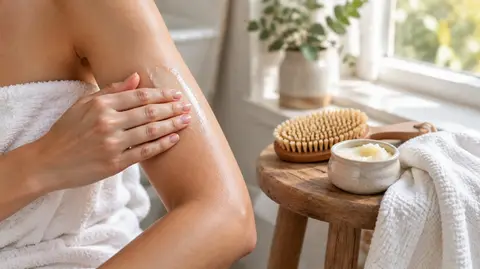
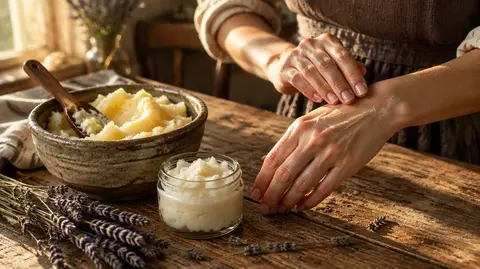
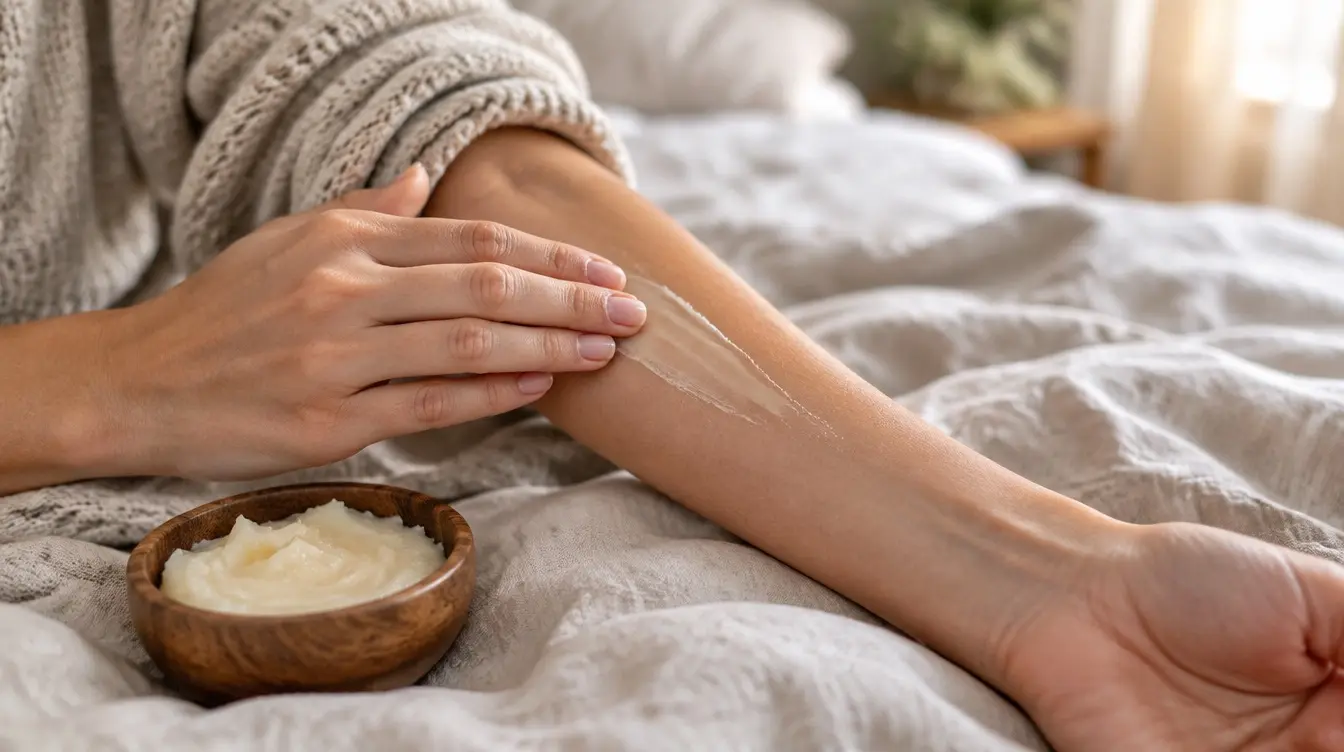
4. Apply tallow within three minutes. This is the part most people get wrong. Damp skin absorbs lipids better than dry skin. The window is small. A small scoop, warmed between fingers, then spread thin across the affected areas.
5. Twice daily for the first month. Morning and night. Even on the days the skin looks calm. Eczema is a cumulative-damage condition. Consistency beats intensity.
6. Stop the suspects. Cut fragrance, essential oils, sulfates, and known irritants from anything else that touches your skin during this month. You cannot evaluate one variable while ten others are changing.
For sensitive eczema-prone skin, I keep coming back to the Terra Lotus Organic Unscented Tallow Balm. The ingredient list is short: tallow, olive oil, and that is essentially it. No essential oils, no fragrance, nothing to react to. The Santa Cruz Paleo Beef Tallow Moisturizer is the other one I reach for. It is three ingredients (tallow, olive oil, honey) and the honey adds a small humectant component that I have found helpful on the driest flares. For larger body areas, the Amallow Unscented Whipped Tallow Balm spreads farther per scoop because of the whipped texture.
If you want a deeper product comparison, the best tallow products for eczema roundup breaks the options down by skin type and budget.
What to Avoid
Most of the trouble I see in eczema-focused tallow forums comes down to product choice, not the tallow itself.
- Essential oils. Lavender, tea tree, frankincense, eucalyptus. All common in scented balms. All known irritants for compromised barriers. Skip them during a flare.
- Fragrance of any kind, “natural” or synthetic. If the label says “fragrance,” “parfum,” or “essential oil blend,” put it back.
- Strong botanical extracts like citrus oils or peppermint, which can be photosensitizing or directly irritating.
- Soap-heavy formulas that strip the lipids you just applied. Switch to a low-pH, fragrance-free body wash.
- Hot showers, long baths, harsh towels. All four damage the barrier mechanically or thermally.
There is also a more controversial item: balms marketed as “raw” or unrefined tallow. For most people they are fine. For some eczema sufferers, residual proteins from incomplete rendering can be allergenic. If you have known beef sensitivity (rare but real), avoid them.
What to Expect on the Timeline
This is where honest expectation-setting matters. Tallow is not a topical steroid. It will not clear an active inflamed flare in 24 hours. The timeline I have seen in myself and in people who have written in:
- Days 1 to 3. Sometimes a “settling” period where skin feels heavy or oily. Some people see immediate itch relief from the occlusive effect.
- Week 1. Visible reduction in flakiness and surface dryness. The barrier is starting to repair.
- Weeks 2 to 4. Inflammation reduces if you have also cut irritants. The cycle slows down.
- Weeks 4 to 12. Real barrier remodeling. This is where the data on physiologic lipids suggests the actual structural improvements happen.
If you are six weeks in and seeing zero improvement, tallow alone is not enough for your case. That is the point where you book the dermatologist if you have not already.
When to See a Dermatologist
You should see a derm before relying on any over-the-counter approach if:
- Your eczema covers more than 10% of your body
- Skin is cracked, weeping, or has signs of infection (yellow crust, increasing redness, warmth, fever)
- Sleep is being affected by the itch
- Topical moisturizers (any of them) have not made a measurable difference in six weeks
- You have a personal or family history of severe atopic disease
Modern eczema care has options the over-the-counter world cannot match: prescription ceramide formulations, topical calcineurin inhibitors, JAK inhibitors, and biologics like dupilumab for moderate-to-severe disease. Tallow can be part of a maintenance routine. It is not a substitute for medical care when the disease is active and severe.
Frequently Asked Questions
Can I use beef tallow on eczema in babies and toddlers?
This is the question I am most cautious about. The safer answer: talk to the pediatrician first. Infant skin is thinner and more permeable, and any reaction is harder to communicate. If you do get cleared to try, use a minimal-ingredient option like the Santa Cruz Paleo balm and patch test for three days before any wider application.
Does tallow help during an active flare or only as maintenance?
Both, but differently. During a flare, tallow helps reduce TEWL and soothes the surface. It will not stop the underlying inflammation. As maintenance between flares, the lipid replenishment may help prevent the next one. The bigger value is in the maintenance window.
How is tallow different from a CeraVe or Eucerin ceramide cream?
Ceramide creams add ceramides directly. Tallow adds cholesterol and free fatty acids but not ceramides. In a perfect world you would use both: the ceramide product for the missing lipid class, the tallow for the cholesterol and fatty acid components. Some people find one works better than the other for them. There is no head-to-head trial that settles it.
Will tallow clog pores on my face if I have eczema there?
Tallow has a comedogenic rating of around 2 out of 5, which is low to moderate. People with eczema on the face usually tolerate it well because the skin is already low in surface oil. If you also have acne or seborrheic dermatitis on the same areas, you may need to test carefully.
Is grass-fed tallow better than grain-fed for eczema?
Slightly, by mechanism. Grass-fed tallow has a higher vitamin K2 and CLA content and a marginally better omega ratio. Whether that translates to measurable barrier outcomes is unproven. If budget is a constraint, conventional tallow is fine. If you can afford grass-fed, get it.
Can tallow replace a topical steroid?
No. Topical steroids work by suppressing the immune response. Tallow works by supporting the barrier. They are doing different jobs. If you have been prescribed a steroid, stay on the plan your derm gave you. Tallow can be part of the moisturizing layer underneath.
Bottom Line
Beef tallow has a strong mechanistic case for eczema-prone skin: the fatty acid profile lines up with what the barrier is missing, the lipids are physiologic rather than occlusive-only, and the basic science of barrier repair supports the approach. The published clinical evidence is thin. The lived experience is, for many people, real and durable.
If you want to try it, start with a patch test, apply to damp skin twice daily for a month, and cut every fragrance and essential oil from your routine during that window. The Terra Lotus unscented or Santa Cruz Paleo are the two minimal-ingredient options I keep recommending for reactive skin. For a wider product breakdown, the eczema product roundup is the next read, and the skin condition guide covers the medical context in more depth.
If six weeks in you are not seeing improvement, book the derm. Tallow is a tool. It is not the only tool.
Explore more tallow guides
Browse our collection of recipes, comparisons, reviews and DIY tutorials.
View all guidesKing Tallow is reader-supported. We research and test the products we recommend, and when you buy through links on this page we may earn a commission at no extra cost to you. See our affiliate disclosure.
This article is for general information and is not medical advice. Patch test new skincare and talk to a dermatologist or doctor about persistent skin conditions.
Published