


McDonald's Beef Tallow Fries: History and a Copycat Recipe
Reader-supportedWhy McDonald's stopped frying in beef tallow in 1990, whether it still uses beef fat today, and a copycat recipe for the original tallow-fried shoestring fry.

This post contains affiliate links. We may earn a commission if you purchase through these links, at no extra cost to you.
McDonald’s fried its fries in a blend that was mostly beef tallow until July 1990, when it switched to vegetable oil after a public campaign against saturated fat. In the US it does not fry in beef tallow today. The fries are cooked in a vegetable oil blend, and McDonald’s lists “natural beef flavor” (containing wheat and milk derivatives) among the ingredients to recover some of the old taste.
This page covers that history and the specific details that made the original fry distinctive: the thin cut, the blanch, the dextrose, and the tallow. It ends with a copycat recipe. For the general method for tallow fries of any cut, use our main beef tallow french fries guide.
McDonald’s Fries Timeline
| Period | Frying fat (as publicly reported) |
|---|---|
| 1950s to July 1990 | ”Formula 47”: roughly 93% beef tallow, 7% cottonseed oil |
| 1990 to mid-2000s | Partially hydrogenated vegetable oil, plus beef flavoring |
| Late 2000s onward (US) | Trans-fat-free vegetable oil blend (canola, corn, soybean) plus “natural beef flavor” |
What McDonald’s Fried In Before 1990
The original blend is widely reported as “Formula 47”: about 93% beef tallow and 7% cottonseed oil. Malcolm Gladwell’s Revisionist History episode “McDonald’s Broke My Heart” (2016) popularized that account, and it matches earlier food histories of the chain. The mostly-tallow blend gave the fries a savory, faintly beefy flavor and a crisp, dry shell.
Why McDonald’s Switched in 1990
The change came out of the 1980s concern over dietary cholesterol and saturated fat. Phil Sokolof, an Omaha businessman who had survived a heart attack, spent his own money on full-page newspaper ads attacking fast-food chains for frying in beef fat. Under that pressure, McDonald’s announced in July 1990 that it would switch to vegetable oil.
The replacement was partially hydrogenated vegetable oil, which avoided beef fat but contained trans fats. Later research found trans fats harmful to heart health, and US chains, McDonald’s included, moved to trans-fat-free oils in the late 2000s. For how tallow compares with those oils on stability and smoke point, see the beef tallow smoke point guide.
Does McDonald’s Still Use Beef Tallow?
Not in the US. McDonald’s US ingredient list describes the fries as potatoes, a vegetable oil blend (canola, corn, soybean, hydrogenated soybean), natural beef flavor (listing wheat and milk derivatives), dextrose, sodium acid pyrophosphate to hold color, and salt. The beef flavoring is added at the potato processing stage, which is why US McDonald’s fries are not vegetarian even though they are not fried in tallow. Formulations differ by country, so check the local McDonald’s ingredient page if this matters to you, and treat the list above as a summary of what McDonald’s publishes rather than a guarantee for every market or date.
Some restaurants, especially independent burger and steak houses, have gone back to frying in tallow. For the dishes that never left it, see 15 traditional foods still cooked with beef tallow.
What Made the Original Fry Distinctive
Copycat cooks have picked apart the original for decades. These are the details that come up most often:
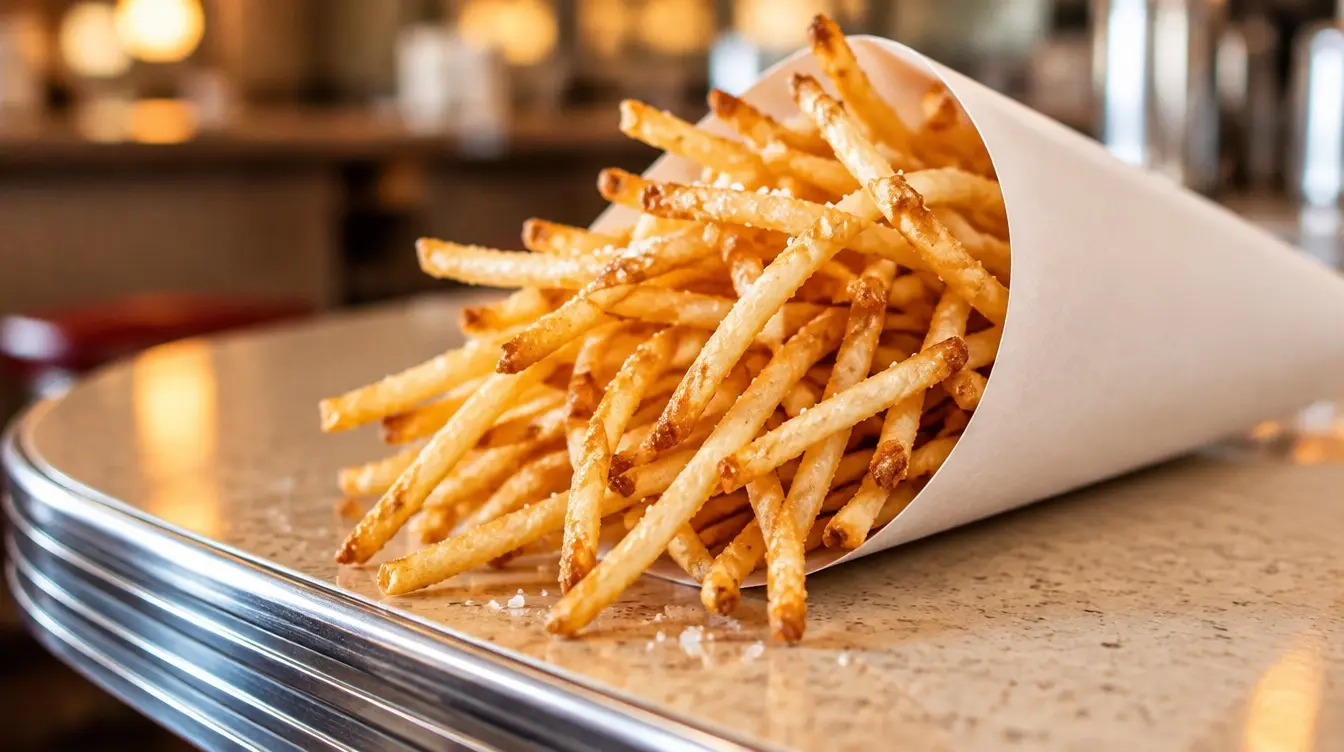
- The cut. A thin shoestring, roughly 1/4 inch square. Thin enough to crisp all the way through, thick enough to keep a soft core.
- The blanch. The potatoes are par-cooked before the final fry. At home, this is a first fry at a lower temperature.
- The sugar. McDonald’s lists dextrose on its fry ingredients; it browns evenly and gives the fry its uniform golden color. Copycat recipes imitate this with a short dip in sugar water or light corn syrup water before frying.
- The fat. Mostly beef tallow before 1990. This is the part a home cook can match exactly.
- The salt. Fine salt, applied the second the fries leave the fat.
Copycat Recipe: Pre-1990 Style Tallow Fries
This is a condensed version. The main tallow fries guide covers each step, troubleshooting, and how much tallow different pots need in more detail.
You need: about 3 lb Russet potatoes, 2 tablespoons sugar or light corn syrup, fine salt, and enough beef tallow to reach about 1.5 to 2 inches deep in your pot. For a 6-quart Dutch oven that is roughly 4 to 5 pounds. A 4-lb tub of grass-fed tallow covers most of that, and a Traverse Bay 32 oz jar is a lower-cost way to top it up. A clip-on thermometer such as the ThermoPro TP509 and a spider strainer make the two temperature stages easy to hit.
- Cut. Peel the Russets for the McDonald’s look, then cut into 1/4-inch shoestrings.
- Soak. Cover with cold water and soak at least 30 minutes, up to overnight in the fridge.
- Sugar dip. Drain. Stir the sugar or corn syrup into about 2 quarts of warm water and soak the fries in it for 5 to 10 minutes. This is the copycat stand-in for dextrose.
- Dry. Drain and pat completely dry on towels.
- First fry at 325°F. Fry in small batches for 3 to 5 minutes (shoestrings cook faster than thicker fries) until limp and pale. Drain on a rack.
- Rest or chill. Rest at least 10 minutes. For the closest match to a restaurant’s par-cooked, frozen fries, spread the blanched fries on a sheet pan and freeze them for an hour or more, then fry from frozen.
- Second fry at 375°F. Fry 2 to 4 minutes until golden and crisp.
- Salt immediately with fine salt and serve.
Because of the sugar, these fries brown faster than plain fries. Pull them when they are golden rather than waiting for deep brown.
Gear for Home Frying
A heavy Dutch oven with a clip thermometer is enough. If you plan to make these regularly, an electric fryer with a thermostat holds 375°F more steadily between batches. Our best deep fryer for beef tallow guide covers how much tallow each fryer needs and which designs handle solid fat.
After frying, strain the tallow through a fine-mesh strainer lined with cheesecloth or a coffee filter and refrigerate it. The reuse guide explains how many sessions to expect and when to discard it.
Frequently Asked Questions
When did McDonald’s stop using beef tallow?
McDonald’s announced the switch to vegetable oil in July 1990.
Why did McDonald’s stop frying in beef tallow?
Public pressure over saturated fat and cholesterol, led largely by Phil Sokolof’s newspaper ad campaign, pushed the chain to vegetable oil.
Are McDonald’s fries vegetarian?
In the US, no. McDonald’s lists natural beef flavor, containing wheat and milk derivatives, on its fry ingredients. Other countries use different recipes.
Can I use frozen fries for a copycat?
Yes. Frozen shoestring fries are already blanched. Fry them from frozen in tallow at 350°F to 375°F until golden. It is the fastest route to a tallow-fried shoestring.
Will these taste exactly like the originals?
Nobody can confirm that from memory alone, and the potatoes and processing have changed since 1990. Frying a thin, sugar-dipped, double-fried Russet in beef tallow does reproduce the elements the original is documented to have had.
Bottom Line
McDonald’s fried in a mostly beef tallow blend until 1990, switched to vegetable oil under public pressure, and in the US now adds beef flavoring to a vegetable oil fry. To recreate the older fry, cut thin Russets, soak, dip in sugar water, double fry in tallow at 325°F and 375°F, and salt immediately. For every other kind of tallow fry, start with the main tallow french fries guide, or browse our cooking french fries in tallow page and deep frying with tallow.
Explore more tallow guides
Browse our collection of recipes, comparisons, reviews and DIY tutorials.
View all guidesKing Tallow is reader-supported. We research and test the products we recommend, and when you buy through links on this page we may earn a commission at no extra cost to you. See our affiliate disclosure.
Published · Last updated