How long does homemade tallow body butter last? ▼
Six months at room temperature in a sealed glass jar; nine months if you add 8 drops of mixed-tocopherol vitamin E at the cooling step; up to twelve months refrigerated. Shelf life is bounded by the unsaturated fats oxidizing, not by microbial spoilage, because the formula is anhydrous.
Why is my whipped butter grainy? ▼
Shea butter re-crystallized in coarse grains because the blend cooled too slowly or was overheated past 180 °F. Re-melt the whole batch to 175 °F, hold 15 minutes to dissolve the seed crystals, then quench in an ice-water bath while stirring constantly until 70 °F before whipping.
Will it melt in my bathroom? ▼
If your bathroom regularly exceeds 80 °F (typical of summer in Florida, Texas, or any humid subtropical region) the standard recipe will soften and may pool. Use the hot-climate variation with 1 tbsp added beeswax, or store the jar in a bedroom drawer.
Is it safe for sensitive skin / eczema? ▼
Yes, the unscented sensitive variation contains zero of the top six lotion irritants (fragrance, MI, parabens, propylene glycol, lanolin alcohols, formaldehyde-releasers). Tallow's biomimetic fatty-acid profile is one of the few topicals that consistently doesn't trigger atopic skin.
Can I use this on my face? ▼
Yes for normal and dry skin. For acne-prone or oily skin, use sparingly (rice-grain amount), tallow has a comedogenic rating of 2/5, which is moderate. The dedicated face-cream recipe (4:1 tallow:jojoba, no shea) is lighter and a better daily choice for facial use.
Why grass-fed tallow specifically? ▼
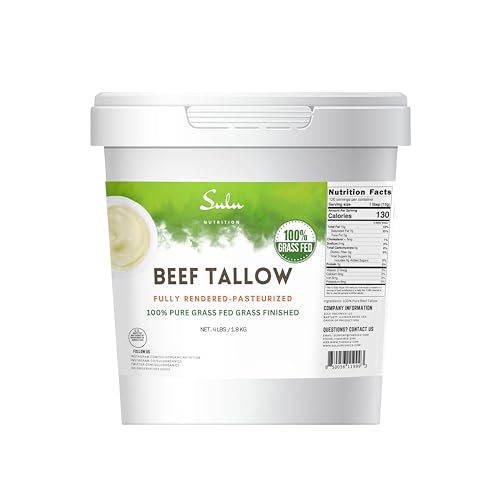
Grass-finished beef tallow contains 2-3× the conjugated linoleic acid (CLA), 5× the beta-carotene (which gives it the soft yellow color), and a higher palmitoleic-acid fraction than grain-finished tallow. All three contribute to skin-barrier outcomes.
Does it smell beefy? ▼
Properly rendered leaf-fat tallow has a faint clean-meat aroma that disappears entirely under any essential oil at 0.5%+ load. The unscented version has a mild buttery-savory smell most users don't notice after the first 30 seconds. If your tallow smells obviously beefy when melted, it was rendered from suet with connective tissue still attached, re-render through cheesecloth or buy cosmetic-grade.
Can I make it vegan? ▼
Substitute mango butter for tallow at a 1.5:1 ratio (i.e. 1.5 cups mango). You lose the palmitoleic acid that makes tallow biomimetic, so the lipid replacement to your skin won't be as complete, but the product still moisturizes well.
Will this clog my pores? ▼
Tallow has a comedogenic rating of 2/5 (moderate). Coconut oil is 4/5. For acne-prone skin on the body, the risk is low because body skin has fewer sebaceous glands than the face. If you do break out, swap the coconut for babassu (rated 1/5).
Can I scale the recipe up to a 32 oz batch? ▼
Double every ingredient. Whip time increases by ≈ 2 minutes. Store half in the fridge and pull out as needed, fridge storage extends the second jar's life to 12 months. Don't try to scale beyond 4× in a home stand mixer; the bowl can't hold the volume.
Why didn't my butter double in volume? ▼
Three possibilities: (1) you whipped too warm, fats above 78 °F won't aerate; (2) you used a stick blender instead of a whisk attachment, sticks emulsify but don't fold air; (3) your shea ratio is off, too little shea and the matrix can't hold air cells.
Can I add water-based actives like aloe juice or hyaluronic acid? ▼
No, not without an emulsifier system more robust than this recipe provides. This is an anhydrous (no added water) formula, adding any water-based ingredient breaks the structure and shortens shelf life to 2-3 weeks because microbes can now grow.
Is it OK if a layer of liquid forms on top of the jar after a few weeks? ▼
A thin oil sheen (1-2 mm) is normal, that's coconut oil migrating through temperature swings. Stir it back in with a clean spoon. If the layer is more than 5 mm or smells off, the emulsion has broken; re-whip after warming in a 80 °F water bath for 30 seconds.
How is this different from a lotion or a cream? ▼
Lotions and creams are emulsions of water and oil held together with emulsifiers and preservatives, typically 60-85% water by weight. This whipped butter is 100% lipid with whipped-in air; no water, no preservatives, no emulsifiers. The trade-off: every gram delivers more skin-identical lipid, but it doesn't 'feel light' the way a water-rich lotion does.
Can I use it as a hair mask? ▼
Yes, apply a small amount to dry hair ends 30 minutes before shampooing. Don't apply to roots; the lipid load is too heavy and will weigh down fine hair.
Why does my butter shrink down in the jar after a week? ▼
The whipped air cells slowly release as gravity compresses the structure, this is cosmetic, not a defect. The product is identical; only the visual volume changed. Re-whip with a fork in the jar if you want the fluffy look back.
Can I use refined shea instead of unrefined? ▼
Technically yes, but you lose 60-80% of the unsaponifiable matter that drives shea's long-acting moisture benefit. Refined shea is bone-white and odorless; unrefined is ivory-yellow and faintly nutty. Always use unrefined for skincare.