

This post contains affiliate links. We may earn a commission if you purchase through these links, at no extra cost to you.
The first time I tried to figure out what “edible tallow” meant on a wholesale spec sheet, I lost about two hours and finished more confused than I started. The grading system for beef fat in the United States is a patchwork. Some of it is USDA. Some of it is industry trade convention. Some of it is just what a particular renderer prints on a barrel.
I want to save you that two hours. This is the post I wish I had read before I started buying tallow in any volume, whether that was a 4 lb block from Amazon or a 50 lb pail from a local butcher.
I will cover the edible grades you actually run into, the difference between edible, inedible, cosmetic-grade, and food-grade, why USDA inspection matters even when grading does not, and what to look for on a retail label so you are not buying perfume-scented hype for ten dollars an ounce.
The Quick Map: Five Categories You Will Run Into
Before grades, here is the bigger structure. Tallow on the market falls into one of five buckets.
- Edible tallow, food grade, USDA-inspected at the slaughter house. This is what you cook with and what reputable skincare brands start with.
- Inedible tallow, industrial grade. Used in biodiesel, animal feed, soap stock, lubricants. Not in your kitchen and not on your face.
- Cosmetic-grade tallow, which is edible tallow processed and deodorized for skincare. The line between cosmetic-grade and food-grade is mostly about deodorizing and packaging, not safety.
- Pharmaceutical-grade tallow, the strictest category, used as an ingredient in ointments and salves with FDA oversight. You will rarely see this at retail.
- Grass-fed or pastured tallow, which is a marketing claim layered on top of any of the categories above. Not a separate grade.
Most of the confusion at the consumer level comes from people assuming “cosmetic-grade” is somehow lower quality than “food-grade.” It is the opposite. Cosmetic-grade is usually more processed, not less.
The Edible Grades: Prime, Choice, Edible #1, Edible #2
The USDA does have a formal grading system for edible beef fats. You almost never see it printed on a consumer jar, but it lives upstream and shapes what you eventually buy. The four grades, in descending order of quality, are these.
Prime tallow. The cleanest, lightest-colored, lowest free-fatty-acid edible tallow. Free fatty acid (FFA) content is the main measurable quality marker. Prime sits at roughly 0.75% FFA or lower. Color rating, measured on a Lovibond scale, is the lightest of the four. This is the grade that ends up at high-end restaurants and the better skincare brands.
Choice tallow. A small step down. FFA up to about 1.0%. Slightly darker color. Still considered fully edible and food-safe. Most premium consumer jars sit somewhere between Prime and Choice in practice.
Edible #1. The mid-market edible grade. FFA up to about 2.0%. Darker color, often a yellow tint. Common in food-service deep-fry applications. The flavor profile is more beefy and assertive, which some cooks actually prefer for fries and seared meat.
Edible #2. The lowest grade still classified as edible. FFA up to about 4.0%. Used heavily in industrial baking, processed foods, and shortening blends. You will not see Edible #2 marketed to consumers as a stand-alone product, but it shows up as an ingredient in commercial fryer oils and prepared foods.
Below Edible #2 sits inedible tallow. That fat is not unsafe in a chemical sense, but it has been pulled out of the food supply chain at the slaughter house, processed in non-food facilities, and is regulated as a different product entirely.
Why “Edible” Is the Word That Matters Most
If you take one thing away from this guide, take this: the line between edible and inedible tallow is not about the cattle. It is about the facility and the chain of custody from the moment the fat leaves the carcass.
Edible tallow is rendered in USDA-inspected facilities. The trimmings are kept cold, processed quickly, filtered, and tested for FFA, color, and moisture. The water used is potable. The equipment is food-contact rated. The product is regulated as a food.
Inedible tallow can come from the same cattle, but the trimmings are sent to a rendering facility that processes whatever animal byproducts come through the door. There is no food-grade chain of custody. The fat is fine for soap, biodiesel, and tannery use. It is not appropriate for eating or skincare, no matter what someone tells you on the internet about saving money.
When a brand says “food-grade tallow” on a skincare jar, what they are signaling is that the fat started life in the edible supply chain. That is the floor you want for anything touching your face or your fryer.
For my own kitchen I have settled on 100% Pure Grass-Fed Beef Tallow (4 lbs), which is sold as fully edible, food-grade, grass-fed, and shows the kind of pale color and faint smell that lines up with a Prime or high Choice spec.
Cosmetic-Grade vs Food-Grade: A Real Distinction
Here is where it gets useful. Cosmetic-grade tallow starts as edible tallow and then goes through additional processing for skincare applications.
The two things that usually happen.
Deodorizing. The fat is gently heated under vacuum, sometimes with steam, to drive off volatile compounds. This pulls out the beefy aroma so you can put a tallow balm on your face without smelling like a Sunday roast. It does not remove the fatty acid profile or the fat-soluble vitamins. It removes the volatile aldehydes and ketones that produce the smell.
Filtration. Multiple-pass filtration through fine mesh and sometimes diatomaceous earth removes any remaining solid particles. The end product is glass-clear when melted and snow-white when set.
That is mostly the difference. Cosmetic-grade tallow is not chemically refined the way industrial seed oils are. There are no solvents, no caustic stripping, no high-heat deodorizing that destroys nutrients. It is the same fat, with the smell pulled out and the visual presentation cleaned up.
If you want to skip DIY and buy a finished cosmetic-grade balm, my long-standing daily pick is Amallow Unscented Whipped Tallow Balm for normal skin and Terra Lotus Organic Unscented Tallow Balm for sensitive skin. For a deodorized but unfinished DIY base, the easiest budget-friendly option is the Traverse Bay Farms Beef Tallow (32 oz), which is sold deodorized and is what I keep on the shelf for balm experiments.
The Role of USDA Inspection
USDA inspection is separate from USDA grading. Grading is voluntary. Inspection is mandatory.
Every cattle carcass slaughtered for commercial sale in the United States is inspected by the USDA Food Safety and Inspection Service. That inspection covers the animal at multiple points, the slaughter facility, and the rendering of edible byproducts including fat trimmings. The little round USDA inspection mark on a fresh meat package is what you are looking for upstream of any tallow you buy.
What this means in practice: a small farm selling rendered tallow from cattle slaughtered at a USDA-inspected processor is just as legitimately food-grade as a national brand. A neighbor who renders fat from a custom-exempt deer-camp-style slaughter is not selling you USDA-inspected tallow, even if their fat is gorgeous. That distinction matters more for the legal labeling than the safety, but it is the reason commercial tallow has to come from a regulated facility.
If you render at home from suet you bought at a USDA-inspected butcher, you have made yourself food-grade tallow in the technical sense. The supply chain is intact.
Why Grass-Fed Has No Separate Grade
This is the question I get asked the most. There is no grass-fed grade in the USDA tallow system because grass-fed is a feed claim, not a quality grade. A grass-fed cow can produce Prime, Choice, Edible #1, or Edible #2 tallow depending on the carcass, the trim, and the rendering process.
What grass-fed actually changes in tallow.
- A higher beta-carotene content, which often shows as a more yellow color (more on that in the white vs yellow tallow guide).
- A higher conjugated linoleic acid (CLA) percentage. Modest, but measurable.
- A slightly higher saturated fat percentage on most studies.
- A more grass-forward flavor that some cooks prefer.
What grass-fed does not change in tallow.
- Smoke point in any meaningful way.
- Shelf life or oxidation rate in any meaningful way.
- Whether or not the fat is food-grade.
The label you want, if grass-fed matters to you, is something like “100% grass-fed and grass-finished.” “Grass-fed” alone can legally describe cattle that ate grass at some point and finished on grain. Grass-finished is the stricter claim. The premium for true grass-finished is real and is the reason a 4 lb jar costs $40-60 instead of $20-30.
What to Actually Read on a Retail Label
If you are standing in front of a jar on Amazon or at a farmer’s market, here is the read order I use.
- Look for the words edible or food-grade somewhere on the label or product description. If neither word appears, ask. Cosmetic-grade is also fine and implies edible in nearly every case I have seen.
- Look for the country of origin. United States cattle and USDA inspection is the cleanest supply chain to verify. New Zealand and Australian tallow is also widely respected, with their own regulatory equivalents.
- Look for grass-fed and grass-finished if that matters to you. Just “grass-fed” is the weaker claim.
- Look for the form. Pail, jar, block, vacuum-sealed brick. Vacuum-sealed gives you the longest unopened shelf life. Pre-opened tubs have a shorter clock once they arrive.
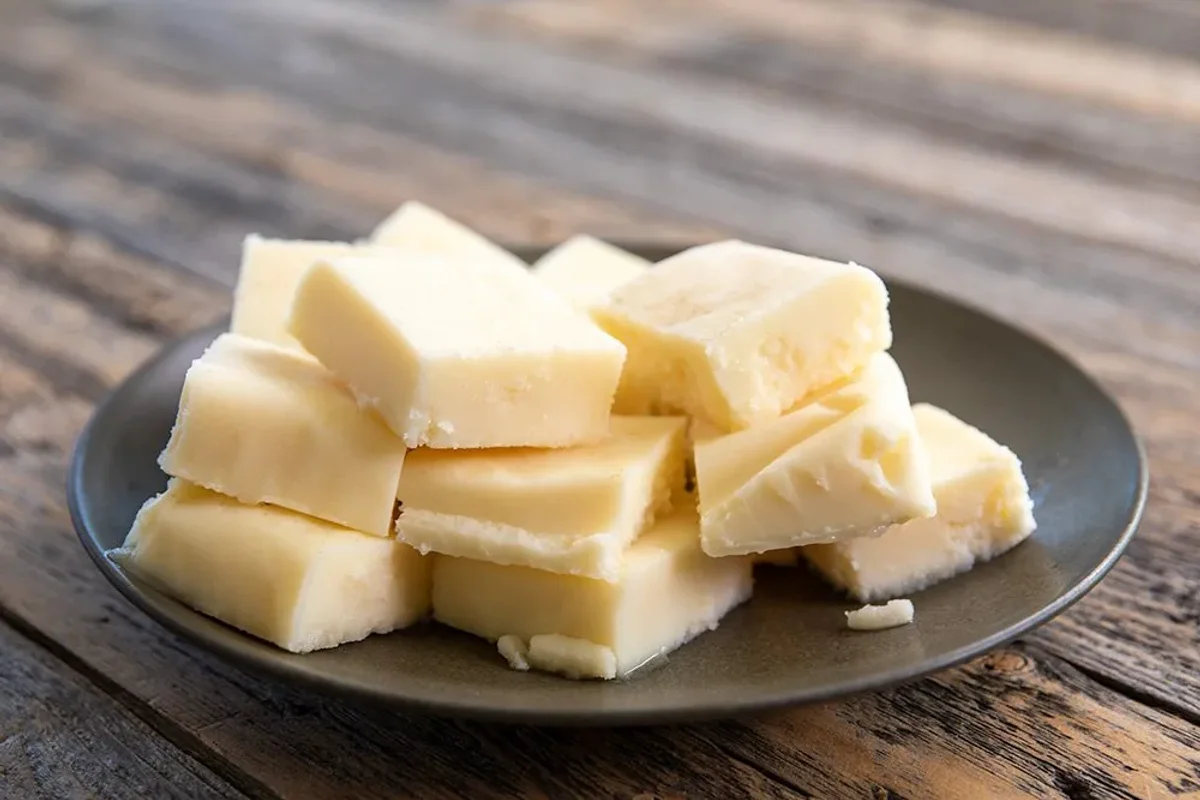
- Look for the color in the photos. Pale cream to soft yellow is normal. Bright white can mean heavy deodorizing (fine for skincare, slightly less interesting for cooking). Deep yellow can mean grass-finished or it can mean a higher-FFA grade. Context matters.
For the related deep dive on how to read color specifically, see the beef tallow color guide and how to identify high-quality beef tallow.
What the Grades Mean for You in Practice
Here is the simplified buying guidance after all of that.
For high-heat cooking and frying: Edible #1 or Choice tallow is usually the sweet spot. You want the beefy flavor and you do not care about a faint yellow color. Anything sold as restaurant-quality fryer tallow lands here.
For everyday cooking, eggs, vegetables, finishing meat: Prime or Choice grass-fed tallow is the right tier. Cleaner flavor, lighter color, food-forward.
For skincare and DIY balms: Prime tallow, cosmetic-grade (deodorized) or food-grade you do not mind smelling like beef while you work. Grass-fed adds carotenoid content and fat-soluble vitamins.
For soap and candles: Edible #2 is fine. The lye reaction and the open flame do not care about FFA elegance. You can save real money on bulk tallow for these projects without losing anything.
For finished skincare where you want the absolute cleanest sensory experience and no DIY, the cosmetic-grade balms I keep recommending are Amallow Unscented, Terra Lotus Unscented, and the minimalist Santa Cruz Paleo Beef Tallow Moisturizer. For DIY, the grass-fed 4 lb block is overkill in volume but unbeatable per ounce, and the Traverse Bay 32 oz jar is the deodorized base I default to for any new balm experiment.
For more on choosing for specific use cases, the best beef tallow on Amazon buyer’s guide lays out the full hierarchy I use.
Frequently Asked Questions
Is there a separate USDA organic grade for tallow?
Yes. Tallow can carry the USDA Organic seal if it comes from certified organic cattle and is processed in a certified organic facility. Organic is a separate certification from grade. You can have organic Prime tallow, organic Choice tallow, and so on. The organic premium is real but small compared to the grass-finished premium.
What is “deodorized” tallow and is it lower quality?
Deodorized tallow has been heated gently under vacuum or steam to remove the volatile compounds that produce the beefy aroma. The fatty acid profile, vitamin content, and overall quality are unchanged. Deodorized is the standard for cosmetic-grade balms because you do not want your face cream smelling like a roast pan. Most consumer skincare jars are deodorized to some degree.
Does the USDA grade my home-rendered tallow?
No. USDA grading is a service for commercial producers. Home rendering from USDA-inspected source meat gives you food-grade tallow in the supply-chain sense, but it does not get a Prime or Choice rating. In practice, careful home rendering from clean fresh suet usually lands in the Prime to high Choice range, which is better than most retail jars.
Is industrial tallow safe to use for non-food crafts like leather conditioner?
Technically yes. Practically I would not. The price gap between food-grade and industrial tallow is small, the food-grade product is cleaner and better-smelling, and you almost certainly do not want unregulated processing on a leather goods that touches your skin or your animals. The Traverse Bay 32 oz at a few dollars per ounce is barely more expensive and the right product for this use.
Why does my Prime-grade jar still smell beefy?
Because Prime is a quality grade, not a deodorizing claim. Prime can be fully scented and is in most home-cook applications. If you want a Prime-grade jar that does not smell of anything, look for “deodorized” or “cosmetic-grade” on the label specifically.
How can I check the FFA of a jar I already bought?
Practically, you cannot at home without a titration kit. What you can check is the color, the smell, and the texture. A jar that is pale, evenly colored, smells faintly beefy and clean, and snaps cleanly when cold is going to be in the Prime to Choice range. A jar that is dark yellow, smells strongly beefy in a not-clean way, or has a sticky surface is in lower-grade territory or starting to oxidize. That is detailed further in the rancid tallow guide.
Bottom Line
Beef tallow grades are simpler than they look once you separate three things: USDA inspection (mandatory, supply-chain level), USDA edible grading (Prime, Choice, Edible #1, Edible #2, based mostly on free fatty acid percentage and color), and marketing claims like grass-fed, organic, and cosmetic-grade that layer on top.
The shortcut for buying retail is this. Look for edible or food-grade language, US or NZ origin with USDA or equivalent inspection, and a pale color in the product photos. If grass-finished matters to you, look for the word “finished,” not just “fed.” For skincare, deodorized cosmetic-grade is the easy path.
If you want one cooking-and-DIY jar to cover the most ground, the grass-fed 4 lb block is what I have used for two years without a single batch turning. If you want a finished, ready-to-use cosmetic balm, Amallow Unscented is the daily pick. Everything else is variations on those two anchors.