

Commercial Beef Tallow Rendering: How the Industry Does It at Scale
Reader-supportedHow commercial beef tallow rendering actually works. Wet vs dry rendering, continuous cookers, centrifuge separation, edible grades, and where the tallow goes.

This post contains affiliate links. We may earn a commission if you purchase through these links, at no extra cost to you.
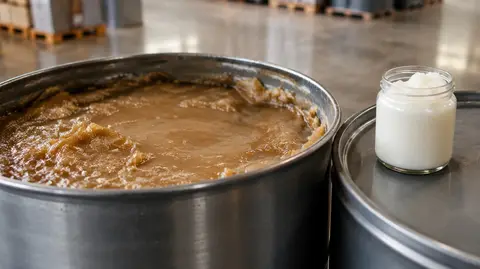
I spent a Saturday afternoon last fall touring a regional rendering plant near Fort Worth. The smell hits you in the parking lot. The scale hits you when you walk inside. The plant processes roughly two million pounds of raw material every day, and beef fat is one of its primary inputs.
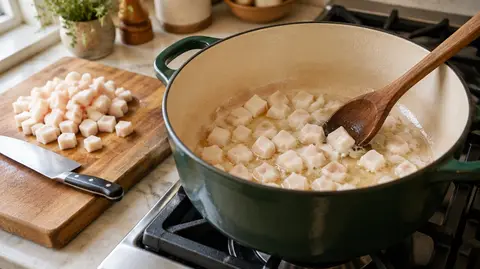
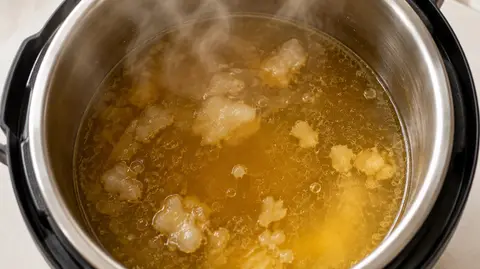
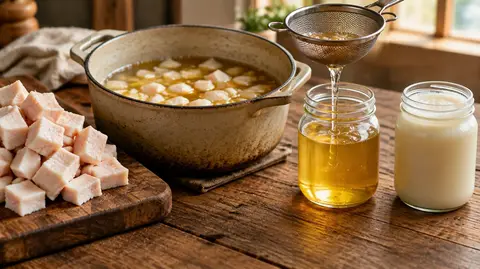
Most articles about tallow are about home rendering. A stockpot, some suet, a few hours, a few jars. That story is real and useful. It is also a tiny fraction of how the tallow in the broader food, fuel, and cosmetic supply gets made.
This post is the industrial picture. How commercial plants render tallow at scale, the difference between wet and dry processes, what continuous cookers actually do, how separation works, what edible versus inedible grades mean, and where the millions of pounds of commercial tallow end up.
If you are a serious DIY renderer, this is the parallel universe your hobby connects to. If you are sourcing tallow for a small skincare business, this is the supply chain you are buying into. If you just want to understand the industry, this is the explainer.
The Two Big Categories: Edible vs Inedible
Before talking process, the most important split in the industry is between edible and inedible rendering.
Edible rendering processes raw material from federally inspected slaughterhouses, under continuous USDA inspection, in plants dedicated entirely to food-grade output. The raw material is fresh, clean, segregated, and traceable to the carcass it came from. The finished product can be sold as food-grade tallow for cooking, baking, or human-grade cosmetic use.
Inedible rendering processes material that is not approved for human consumption: trim from non-federally-inspected facilities, fallen stock, used cooking oil from restaurants, byproducts from further processing plants, and so on. The finished product is sold for animal feed (when allowed), biodiesel feedstock, soap manufacturing, industrial lubricants, and oleochemical production.
The plant I toured did both, but in physically separated facilities with completely different supply chains, equipment, and inspection protocols. A truck delivering raw material to the edible side never crosses the inedible yard, and vice versa.
The vast majority of commercial tallow by volume is inedible grade. The edible market is a fraction of the total but commands much higher prices.
Wet Rendering vs Dry Rendering
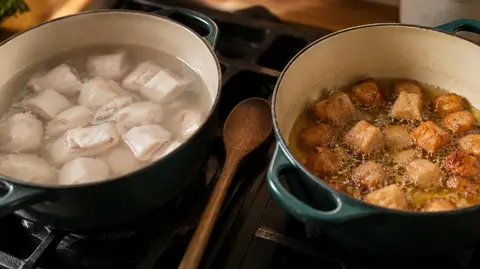
Industrial plants use one of two main processes. Both result in tallow, but they do different things with the protein and water content of the raw material.
Dry Rendering
Dry rendering is the older and simpler of the two. Raw material gets cooked in a jacketed vessel (steam-heated through the walls of the cooker, not through direct contact with the meat) at temperatures of 240 to 290 degrees Fahrenheit for 1 to 3 hours.
The water in the raw material evaporates. The fat melts. The protein matter dries and shrinks into solid particles called cracklings (in the small-batch world) or meat and bone meal (MBM) in the industrial world.
After cooking, the slurry is pumped out into a percolating drainer, where the liquid fat drains away from the dry solids. The solids get pressed in a screw press to recover residual fat. The pressed solids become MBM. The pressed liquid fat goes to a clarifier, then to storage.
Dry rendering produces high-quality tallow with good color and shelf life. It also produces MBM as a salable byproduct (used in animal feed where allowed, fertilizer, and pet food).
The main drawback is energy cost: drying down the water in the raw material takes a lot of steam.
Wet Rendering
Wet rendering is the newer industrial standard for high-volume operations. It separates fat from protein using water, not heat alone.
Raw material gets ground and fed into a pre-heater that brings it to about 180 degrees Fahrenheit. The hot slurry goes into a horizontal decanter centrifuge that spins at high speed and separates the mixture into three streams by density: fat on top, water in the middle, protein solids on the bottom.
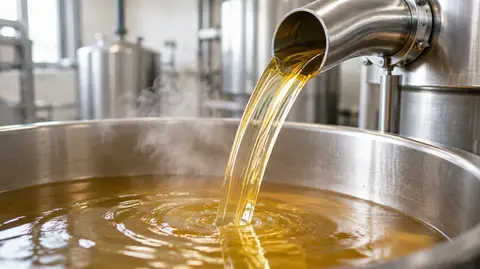
The fat stream goes through a polishing centrifuge to remove any remaining solids and water, then to storage. The water stream (called “stickwater” in the industry) gets concentrated by evaporation and either dried into a protein meal or sold as a liquid concentrate. The solid stream gets dried and pressed into MBM.
Wet rendering uses less energy than dry rendering, produces slightly cleaner tallow, and is the dominant process for large-volume plants. The capital cost is higher and the equipment is more complex.
Most modern plants built in the last 20 years use wet rendering. Older plants that were built in the 1960s and 1970s often still use dry rendering, sometimes upgraded with newer cookers and presses.
The Continuous Cooker
For both wet and dry processes, the cooker is the heart of the operation. Industrial plants do not do batch rendering the way a home cook does. They use continuous cookers.
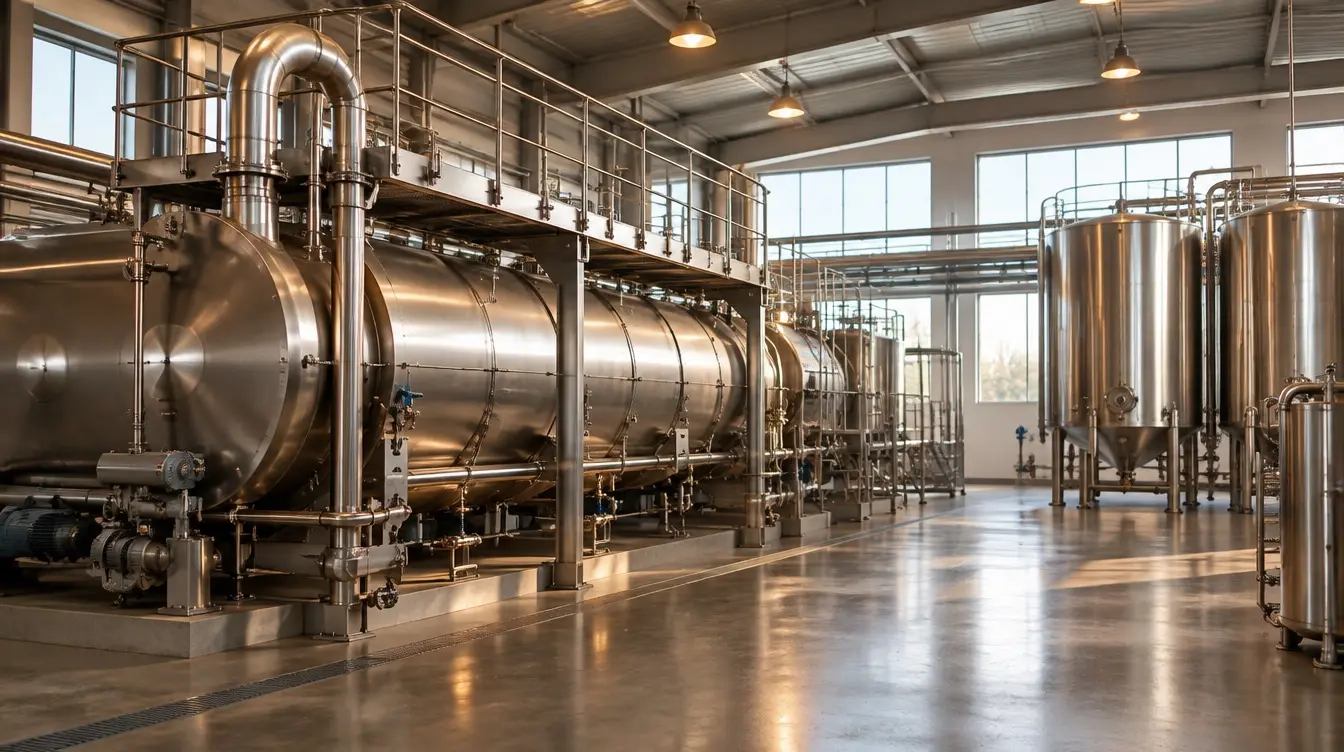
A continuous cooker is a long, jacketed, horizontal cylindrical vessel with internal augers or paddles that move material through the length of the cooker at a controlled rate. Raw material enters one end. Cooked material exits the other end. The plant runs continuously for 18 to 22 hours per day, stopping only for cleaning and maintenance.
A typical industrial continuous cooker is 30 to 50 feet long, holds several thousand pounds of material at any given moment, and processes anywhere from 5,000 to 30,000 pounds per hour depending on plant size.
The continuous design is dramatically more efficient than batch rendering at industrial scale. The cooker stays at steady-state temperature, the energy input is constant, and the throughput is much higher than any batch system could achieve.
Inside the cooker, multiple temperature zones do different jobs: an initial heating zone (heating raw material to about 180 degrees Fahrenheit), a primary cooking zone (220 to 250 degrees Fahrenheit), and a finishing zone (slightly cooler, allowing the cracklings to form fully).
The whole process from raw material entering the cooker to fat and solids exiting takes 60 to 90 minutes, depending on the design and the input material.
Separation: The Centrifuge Step
After cooking, the next critical step is separating the fat from everything else.
Decanter centrifuges handle the bulk separation. These are horizontal centrifuges that spin a continuous stream of material at high speed (around 4,000 to 6,000 rpm) and separate it by density. Fat, water, and solids all exit through different ports.
Disc-stack centrifuges (sometimes called polishing centrifuges) do the final cleanup on the fat stream. They spin even faster (around 7,000 to 10,000 rpm) and remove the last traces of water and fine solids, producing a clear, polished tallow.
For edible-grade product, an additional filtration step often follows: pressure filtration through cellulose pads, which removes any remaining particulates and improves color and clarity. Some plants use bleaching clay at this stage to lighten color further.
Deodorization and Refining
For premium edible and cosmetic-grade tallow, raw rendered fat is further processed in a refining train borrowed from the vegetable oil industry.
Degumming: phospholipids and other impurities are removed using water or acid washes. Most beef tallow does not need much degumming because it does not contain the high phospholipid content of vegetable oils, but some refining plants run a light degumming step anyway.
Neutralization: free fatty acids are removed by reaction with caustic soda, then washed out. This is the step that produces the very pale, very neutral-flavored tallow used in baking and high-end cosmetics.
Bleaching: bleaching clay (usually a treated bentonite) is mixed with the tallow under vacuum, then filtered out. The clay adsorbs color compounds and improves the visual appearance of the finished product.
Deodorization: the bleached tallow is sprayed into a tall vacuum column at high temperature (around 450 degrees Fahrenheit) while steam is injected. The steam carries away volatile flavor and odor compounds, leaving a nearly scent-free, nearly flavorless tallow.
A fully refined, bleached, and deodorized tallow (RBD tallow in industry shorthand) is what you find in commercial baking applications, processed foods, and many cosmetic raw materials. RBD tallow is nearly water-clear when melted and has almost no scent.
The home-renderer aesthetic of pale yellow, slightly beefy-scented tallow is the unrefined endpoint. The industrial RBD endpoint is a different product entirely. Both are legitimate. They serve different markets.
USDA Inspection and Compliance
Edible rendering plants operate under continuous USDA inspection. The Food Safety and Inspection Service (FSIS) maintains inspectors on site during all production hours. Every shift is documented. Every batch is traceable.
The inspection rules cover:
- Source material verification (only material from federally inspected slaughterhouses or processing plants is allowed)
- Temperature and time validation (cookers must hit verified minimum temperatures for verified minimum times)
- Sanitation protocols (clean-in-place systems, allergen controls, foreign material prevention)
- Finished product testing (FFA, moisture, color, microbial)
- Labeling and traceability (each lot can be traced back to source material)
Inedible plants have less stringent inspection, mostly under state and EPA authority for environmental compliance rather than food safety. They cannot sell into the human food chain at all.
The distinction matters when you buy commercial tallow. Anything labeled “food grade” or “edible” came out of a USDA-inspected facility. Anything labeled “industrial” or “technical” came out of an inedible plant and should not be eaten regardless of how clean it looks.
For the home buyer, brands like 100% Pure Grass-Fed Beef Tallow and Traverse Bay Farms source from USDA-inspected supply chains, which is part of what you pay the premium for over bulk industrial tallow.
Byproducts: What Else Comes Out of a Rendering Plant
A modern rendering plant is a zero-waste operation. Everything that goes in comes out as a sold product.
Tallow itself is the primary fat output, sold to food manufacturers, cosmetic producers, soap makers, biodiesel refineries, and animal feed mills.
Meat and bone meal (MBM) is the protein and bone solids dried into a powder. Used in animal feed (where regulations allow), pet food, fertilizer, and aquaculture feed.
Stickwater concentrate is the water phase from wet rendering, concentrated to a syrup. Often dried into a protein meal or sold as a liquid feed ingredient.
Gelatin is produced from selected raw materials (specifically hides, bones, and connective tissue) in plants that run a specialized acid-extraction process. The gelatin industry is a sibling industry to rendering, often with overlapping ownership.
Tallow fatty acids are produced by splitting tallow into glycerine and free fatty acids. The fatty acids go into soap, lubricants, candles, plastics, rubber processing, and personal care. Glycerine is a separate revenue stream sold to pharmaceutical, food, and personal care manufacturers.
The economics of a rendering plant depend on the relative prices of all these output streams. A few years ago, biodiesel demand pushed tallow prices to historic highs. A few years before that, low tallow prices made MBM the primary revenue driver. The industry tracks all of these markets carefully.
Where Commercial Tallow Goes
The roughly 4 billion pounds of beef tallow produced annually in the US ends up in a few main destinations.
Biodiesel has become the largest single consumer of US tallow in recent years. The Renewable Fuel Standard (RFS) created market demand for tallow as a feedstock for renewable diesel and biodiesel, and a significant portion of US tallow production now flows to fuel refineries.
Animal feed has historically been the largest consumer, particularly for poultry and aquaculture feed where tallow provides high-energy fat content. Regulatory changes (particularly the BSE-related restrictions on feeding ruminant-derived material back to ruminants) have shifted some of this volume.
Soap and personal care uses both rendered tallow directly and tallow-derived fatty acids. Sodium tallowate (the soap salt of tallow fatty acids) is still a primary ingredient in many bar soaps, even those marketed under modern brand names.
Food use is the smallest volume but the highest margin segment. Restaurant frying, commercial bakery, and specialty food products consume hundreds of millions of pounds of edible tallow annually. The home cooking tallow you buy in a jar is a tiny slice of this market.
Industrial uses (lubricants, leather processing, plastics, rubber, coatings) consume another significant volume, primarily from inedible-grade tallow.
What This Means for Buyers
If you are buying tallow for home use, this industry context matters in a few practical ways.
Premium prices reflect supply chain costs: a $30 jar of grass-fed tallow is more expensive than a $5 jar of industrial-grade tallow at the bulk level because the supply chain has more steps, more verification, and tighter quality control. Both are legitimate products for different uses.
Refined vs unrefined matters: the very pale, nearly scentless commercial tallow sold for baking is the refined endpoint of the industrial process. The pale yellow, mildly beefy tallow from a small-batch renderer is the unrefined endpoint. Neither is wrong. Pick the one that matches your use case.
Grass-fed claims need certification: at industrial scale, “grass-fed” is a verified supply chain claim, not a casual descriptor. Look for third-party certification (American Grassfed Association is the gold standard in the US) rather than just label language.
Edible vs technical grade matters: anything you eat, cook with, or put on your skin should come from an edible-grade supply chain. Industrial-grade tallow is for soap, biodiesel, and lubricant uses only.
For most home buyers, the safest path is buying from brands that disclose their source and certifications. The skincare-focused brands and cooking-focused brands I have tested all source from verified edible-grade supply chains.
The Future of Commercial Rendering
A few industry trends worth noting if you follow this space.
Renewable diesel continues to grow as a demand source for tallow, which is creating tension between fuel and food uses of the same material. This is similar to the corn ethanol debate of the early 2000s.
Plant-based alternatives in soap and personal care are slowly reducing tallow demand in those sectors, though sodium tallowate remains cheaper and performs better than most plant alternatives in bar soap applications.
Regenerative and grass-fed supply chains are growing in the premium segment as consumer demand for verified sourcing increases. The premium tallow market is a small but rapidly growing slice of the total.
Automation and continuous-process improvement continue to drive down per-pound rendering costs at the industrial level, which keeps commodity tallow prices low even as premium tier prices climb.
Frequently Asked Questions
Is commercial tallow worse than home-rendered tallow?
Not necessarily. Edible-grade commercial tallow from a reputable supply chain is often cleaner, more consistent, and longer shelf-life than home-rendered tallow. The trade-off is character: home tallow has more flavor and color, which some people prefer.
Why is some commercial tallow nearly white and other commercial tallow yellow?
White or pale tallow has been through refining (bleaching and deodorization). Yellow tallow is unrefined and contains more of the original beta-carotene from grass-fed cattle diets. Yellow is not better or worse, just less processed.
Does USDA inspection guarantee quality?
USDA inspection guarantees compliance with federal food safety standards. It does not guarantee premium quality, flavor, or sourcing claims like grass-fed. Look for additional certifications for those.
What does “rendered” mean on a tallow label?
“Rendered” just means the fat was heated and the impurities separated. Almost all commercial tallow is rendered (the alternative would be raw suet, which is sold uncooked at butcher counters). The interesting label questions are about source, refining level, and certification, not rendering itself.
Can I buy industrial-grade tallow cheaper?
You can buy bulk industrial-grade tallow through some specialty suppliers, but it is sold for soap making, biodiesel, and similar uses, not for human consumption. The price difference does not justify the food safety risk for kitchen or skincare use.
How is biodiesel tallow different from food tallow?
Biodiesel feedstock tallow is typically inedible-grade and may contain free fatty acids, moisture, and impurities that would be rejected by an edible-grade buyer. The biodiesel process can tolerate these impurities because the chemistry of transesterification handles them. Food-grade tallow has tighter specifications across the board.
Bottom Line
Commercial beef tallow rendering is an industrial process running at a scale most home renderers never see. Continuous cookers process thousands of pounds per hour, centrifuges separate fat from water from solids in seconds, and refining trains produce a clean, neutral product for food, cosmetic, fuel, and industrial markets.
For home buyers, the takeaway is that the tallow you buy in a jar comes from one of two worlds: edible-grade plants under continuous USDA inspection (where the premium and specialty brands source) or inedible-grade plants serving the industrial market. Stick with edible-grade for anything you eat or put on your skin.
For small business buyers, understanding the industry tier (commodity vs verified-source vs grass-fed premium) helps you make informed sourcing decisions. The supply chain you buy into is part of what your customers are paying for.
If you want to taste the home-rendered endpoint of this story, render a few pounds of suet using the yield math from my yield calculator and compare it to a refined commercial product like Traverse Bay Farms 32 oz or an unrefined small-batch product like 100% Pure Grass-Fed Beef Tallow. The differences in color, scent, and behavior tell the story of the industry better than any article can.
Explore more tallow guides
Browse our collection of recipes, comparisons, reviews and DIY tutorials.
View all guidesKing Tallow is reader-supported. We research and test the products we recommend, and when you buy through links on this page we may earn a commission at no extra cost to you. See our affiliate disclosure.
Published