



Beef Tallow Fatty Acid Profile: CLA, Omega-3, and Saturated Fat Facts
Reader-supportedComplete fatty acid breakdown of beef tallow. Palmitic, oleic, stearic, CLA, omega-3, and how grass-fed differs from grain-fed. Sources cited.

This post contains affiliate links. We may earn a commission if you purchase through these links, at no extra cost to you.
I get a lot of questions about what is actually in beef tallow, and most of the answers floating around the internet are either oversimplified (“it is just saturated fat”) or wrong in a way that takes 20 minutes to unpack. So this post is the one I send people. It is the fatty acid breakdown in full, with the metabolic role of each fatty acid explained in plain English, and the grass-fed versus grain-fed differences pulled out where they actually matter.
I am not a registered dietitian. What I am is someone who cooks with this fat every day, has read enough of the nutrition literature to keep up, and has a strong dislike for marketing that fudges the numbers. Where I pull from a study, I will name it. Where I am giving you my own read, I will say so.
The Big Picture: Beef Tallow Is Roughly Half Saturated, Half Unsaturated
The first thing to understand is that beef tallow is not “all saturated fat.” It is closer to half and half. Per the USDA FoodData Central entry for beef tallow, the fatty acid breakdown of a typical commercial sample runs something like this:
- Palmitic acid (C16:0, saturated): around 26%
- Oleic acid (C18:1, monounsaturated): around 36%
- Stearic acid (C18:0, saturated): around 14%
- Palmitoleic acid (C16:1, monounsaturated): around 3%
- Myristic acid (C14:0, saturated): around 3%
- Linoleic acid (C18:2, polyunsaturated omega-6): around 1%
- Vaccenic acid and conjugated linoleic acid (CLA): 1 to 2% in grass-fed
- Smaller fractions of lauric, capric, and longer-chain saturated and unsaturated fats fill the rest
Add up the saturates and you get roughly 43%. Add up the monos and you get roughly 39%. The polyunsaturates are the smallest piece, around 3 to 4%. That makes beef tallow far less polyunsaturated than seed oils, which matters for oxidation behavior at high heat, and slightly more saturated than olive oil. It is closer in composition to cocoa butter than it is to lard.
That distribution is also what gives tallow its melting profile. Pure tallow softens around 95F, melts fully around 113F, and resolidifies as it cools. The high stearic-and-palmitic combination creates the firm, scoopable texture at room temperature.
Oleic Acid: The Largest Single Component
Oleic acid is the same monounsaturated fat that dominates olive oil. In beef tallow it makes up roughly a third of the total fatty acids. It is metabolically neutral to mildly beneficial in the lipid panel literature. The seminal work here is Mensink and Katan’s 1992 NEJM trial showing that oleic acid replacing carbohydrate calories raised HDL without raising LDL, and the follow-up meta-analyses have largely held that finding up.
For practical purposes, the oleic acid in tallow is the reason you can cook with it at moderately high heat without significant oxidation. Oleic has one double bond. Polyunsaturated fats have two or more, and each additional double bond is another site for oxidation. Tallow’s roughly 36% oleic content gives you a fat that behaves more like olive oil in the pan than like corn oil.
Palmitic Acid: The Most Misunderstood Saturated Fat
Palmitic acid is the most abundant saturated fat in beef tallow at about 26%. It is also the saturated fat that has historically been singled out in cardiovascular research, because it does modestly raise LDL cholesterol in controlled feeding studies.
What gets lost in the simplification is that palmitic acid’s effect on LDL is dose-dependent and context-dependent. In a high-carbohydrate background diet, palmitic acid raises LDL more meaningfully. In a low-carbohydrate background diet, the same palmitic intake has a much smaller effect on the lipid panel. This is why the same fat can produce different results in different study populations.
Astrup et al.’s 2020 review in the Journal of the American College of Cardiology argued that the saturated-fat-cardiovascular link is weaker than the 1980s and 1990s literature suggested, particularly when saturated fat replaces refined carbohydrate calories rather than displacing polyunsaturated fats. That is the relevant context for most people cooking with tallow. You are not adding it on top of a Standard American Diet. You are using it instead of seed oils.
Stearic Acid: The Metabolically Neutral One
Stearic acid is about 14% of beef tallow and it is the saturated fat that most people, even nutrition-aware people, do not realize behaves differently from the others. Stearic acid does not raise LDL cholesterol in controlled feeding studies. It also does not raise HDL. It is essentially metabolically neutral on the lipid panel.
The reason is that stearic acid is rapidly converted to oleic acid in the liver. By the time the body is metabolizing it, a significant fraction of dietary stearic has been desaturated into the monounsaturated form. The European Journal of Nutrition published a thorough review by Gebauer et al. in 2008 making exactly this point. Stearic acid is not the saturated fat to worry about.
When people say “tallow is healthier than you think,” part of what they are pointing at is the stearic acid content. That 14% of the fatty acid profile is metabolically equivalent to monounsaturated fat in most relevant ways.
Conjugated Linoleic Acid (CLA): Where Grass-Fed Wins
CLA is the fatty acid that has generated the most preliminary excitement in the tallow literature. It is a naturally occurring trans fat (different from industrial trans fats) found in the milk and meat of ruminant animals. Grass-fed cattle produce two to five times more CLA than grain-fed cattle, because the rumen bacteria that convert linoleic acid to CLA are more active on a forage diet than a grain diet.
In grass-fed beef tallow, CLA plus vaccenic acid (the precursor) typically runs 1 to 2% of total fatty acids. In grain-fed it runs closer to 0.4 to 0.6%. So you are not getting therapeutic CLA doses from tallow at any feeding system, but you are getting meaningfully more from grass-finished animals.
The CLA literature is mixed but interesting. There is animal evidence for anticancer effects, anti-inflammatory effects, and body composition effects. The human evidence is weaker. Belury’s 2002 review in Annual Review of Nutrition is the standard reference and it lays out the gap between rodent results and human trials honestly. I do not buy tallow for the CLA. But the CLA difference is one of several reasons grass-finished is worth the premium.
Omega-3 Fatty Acids: Small but Present in Grass-Fed
Beef tallow is not an omega-3 source. Fish is an omega-3 source. But grass-fed tallow has a measurable amount of alpha-linolenic acid (ALA, the plant-derived omega-3) that grain-fed tallow largely lacks. We are talking about fractions of a percent of total fatty acids, so the absolute amounts are small.
What matters more than the absolute number is the omega-6 to omega-3 ratio. Grain-fed beef fat can have a ratio of 10:1 or worse, because the corn and soy in the finishing diet drive up linoleic acid (omega-6) content. Grass-fed beef fat lands closer to 2:1 to 4:1, which is closer to what evolutionary nutrition models suggest is ideal.
If your goal is to bring down the average omega-6 load in your diet, switching from seed oils to tallow does the heavy lifting. Picking grass-finished tallow over grain-finished is a smaller second improvement on top of that.
Linoleic Acid: Why Low Is Good for Cooking Fat
Polyunsaturated fats oxidize at cooking temperatures. Linoleic acid, the dominant polyunsaturate in seed oils, has two double bonds, both of which are vulnerable to heat-induced oxidation. The breakdown products include compounds like 4-hydroxynonenal (4-HNE), which has been implicated in cellular oxidative stress.
Beef tallow has only about 1% linoleic acid. That low number is the technical reason tallow performs so well at high heat. There is almost nothing in it to oxidize. By comparison, soybean oil is roughly 51% linoleic acid. When you fry french fries in tallow at 350F, the fat coming back into the fryer at the end of the day looks and smells almost identical to what went in. When you fry the same fries in soybean oil and re-use it for a week, the smell is unmistakably different.
This is why fast food restaurants used to fry in beef tallow before the 1990 industry-wide switch to vegetable oil, and why some of them have been switching back. The cooking performance was always better.
The Sydney Diet-Heart Study Reanalysis
If you want to understand why the conventional wisdom on saturated fat has been slowly walking itself back over the last decade, the single most important paper is Ramsden et al.’s 2016 BMJ reanalysis of the Sydney Diet-Heart Study. The original 1970s trial had replaced animal fats with safflower oil (linoleic acid) in a group of men with heart disease. The original conclusion was that the swap was beneficial. Ramsden recovered the raw data, reran the analysis, and found that the safflower oil group actually had higher all-cause mortality and higher cardiovascular mortality than the animal fat group.
This does not prove that tallow is better than seed oils. It proves that the original study, which has been cited thousands of times in the saturated-fat-bad consensus, did not support its own headline conclusion. The fatty acid story is more complicated than a 1980s nutrition textbook would have you believe.
How Rendering Affects the Profile
Properly rendered tallow preserves the fatty acid profile of the source fat almost completely. Rendering happens at temperatures well below the breakdown points of any of the major fatty acids. Where you can lose nutritional quality is in the fat-soluble vitamins (A, D, E, K2) and the carotenoids, which are more heat-sensitive than the fatty acids themselves.
Low-and-slow rendering, in the 200F range for several hours, preserves the most. High-heat industrial rendering at 250F or above can degrade some of the vitamin K2 and carotenoid content. This is one of the rare cases where artisanal small-batch rendering produces a measurably better product than commercial.
If you want to play with rendering yourself, the home rendering guide covers the temperature math.
What This Means When You Are Standing in the Grocery Aisle
If you are picking between a grass-fed and a grain-fed tallow at the store, the differences that matter most are:
- CLA: two to five times higher in grass-fed
- Omega-6:omega-3 ratio: significantly better in grass-fed
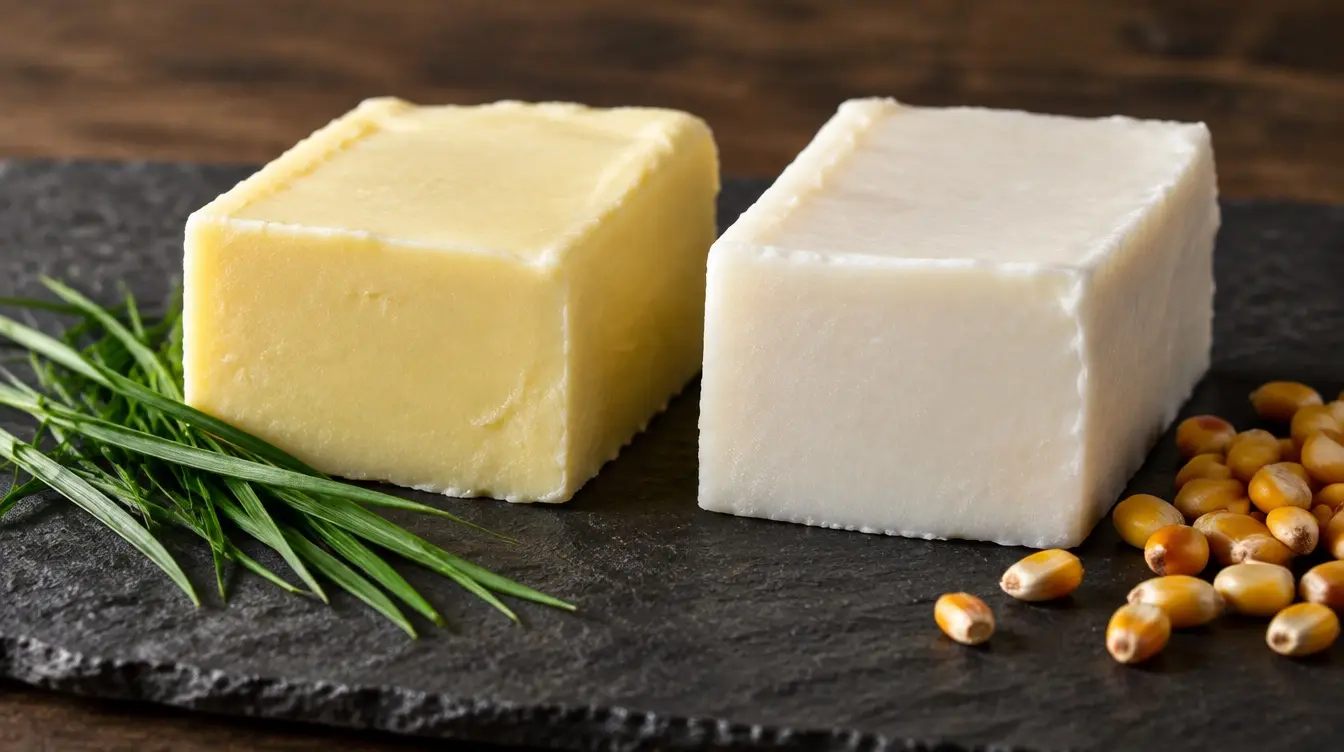
- Vitamin K2 and carotenoids: higher in grass-fed (visible as a yellower color)
- Palmitic, oleic, and stearic: similar between the two
The saturated-fat backbone of tallow is roughly the same regardless of feeding system. The micronutrient and minor fatty acid story is where grass-finished earns the premium. For everyday cooking, both are fine. For daily raw consumption on carnivore, grass-finished is worth it.
A reliable bulk option I keep using is the 100% Pure Grass-Fed Beef Tallow (4 lbs). For a smaller, neutral-tasting jar for raw use, the Traverse Bay Farms 32 oz is what lives on my counter.
Frequently Asked Questions
How much CLA is in a tablespoon of grass-fed tallow?
About 130 to 280 milligrams, depending on the source animal and feeding system. Most clinical studies on CLA have used doses of 3 to 6 grams per day, so you are not hitting therapeutic levels from tallow alone. Treat the CLA as a small bonus, not the headline reason to choose grass-fed.
Does cooking destroy any of the fatty acids?
Not at normal cooking temperatures. The saturated and monounsaturated fatty acids in tallow are stable up to and beyond 400F. The 1% linoleic acid will partially oxidize at very high heat over long periods, which is why repeatedly used fryer fat eventually starts to taste off. The fat-soluble vitamins are more vulnerable to heat than the fatty acids themselves.
How does tallow compare to lard on the fatty acid profile?
Lard (pork fat) is higher in monounsaturated oleic acid (around 45%) and higher in polyunsaturated linoleic acid (around 10%), which makes it less heat-stable than tallow but slightly softer at room temperature. Tallow has more stearic acid and less polyunsaturated fat. Both are good cooking fats. Tallow is the more stable one at high heat.
Is the cholesterol in tallow a problem?
A tablespoon of tallow has about 14 milligrams of cholesterol. Dietary cholesterol has been largely cleared as a meaningful driver of blood cholesterol levels in the 2015 USDA Dietary Guidelines update. Most healthy adults can eat tallow without thinking about the cholesterol number.
What is the omega-6 content of grass-fed versus grain-fed tallow?
Grass-fed tallow runs about 1 to 1.5% linoleic acid. Grain-fed runs about 2 to 3.5%. Both are dramatically lower than seed oils, which run 40 to 70% linoleic acid. The grass-fed-versus-grain-fed difference matters most for the omega-6 to omega-3 ratio rather than the absolute omega-6 number.
Are the saturated fats in tallow inflammatory?
The “all saturated fat is inflammatory” framing comes from older studies that did not separate stearic acid from palmitic acid, and did not control for the carbohydrate background of the diet. The current consensus, reflected in the Astrup 2020 review, is more nuanced. Stearic acid is neutral. Palmitic acid is mildly LDL-raising in a high-carb context. The blanket “inflammatory” label does not hold up.
Bottom Line
Beef tallow’s fatty acid profile is roughly 43% saturated, 39% monounsaturated, and 3 to 4% polyunsaturated. The dominant saturated fats are palmitic (modestly LDL-raising in some contexts) and stearic (metabolically neutral). The dominant monounsaturated fat is oleic, the same as olive oil. The polyunsaturated content is low enough that tallow performs better than almost any other cooking fat at high heat.
Grass-fed and grass-finished tallow has two to five times more CLA, meaningfully more omega-3, and a better omega-6 to omega-3 ratio than grain-fed. For cooking, both are excellent. For daily raw consumption, the grass-fed premium is worth paying. The 4-pound grass-fed bucket is my default purchase.
If you want to go deeper on the cooking performance side, the smoke point and temperature guide goes into oxidation behavior in detail. For the health-claims side, the nutrition science overview covers the cardiovascular literature. The grass-fed versus grain-fed comparison is the natural follow-up read for anyone who skimmed this and wants the visual side-by-side.
Explore more tallow guides
Browse our collection of recipes, comparisons, reviews and DIY tutorials.
View all guidesKing Tallow is reader-supported. We research and test the products we recommend, and when you buy through links on this page we may earn a commission at no extra cost to you. See our affiliate disclosure.
Published