

This post contains affiliate links. We may earn a commission if you purchase through these links, at no extra cost to you.
The first time I made tallow body butter I let it slow-cool overnight on the counter. It was great. It was also a two-day project, and I have made it that way exactly twice since. The version I actually use is a 20-minute recipe I worked out one Saturday morning when my wife asked if I could whip up a jar before her hands started cracking again.
This is that recipe. Mixer, ice bath, jar, done. It is slightly denser than the slow-cool version. I will get into why in a second. But for daily lotion duty, it is the one I keep making.
If you want the longer, fluffier, more cloud-like body butter, the full guide lives at /make/body-butter/. What follows is the fast version for people who want a jar in their hand by lunch.
The Recipe
This makes about 24 ounces, which fits cleanly into two 12 oz wide-mouth Mason jars or three 8 oz tins.
- 1 cup rendered beef tallow (8 oz by weight)
- 1/2 cup raw shea butter
- 1/4 cup unrefined coconut oil
- 2 tablespoons jojoba oil
- 20 to 30 drops essential oil (optional)
The tallow is the star. I use 100% Pure Grass-Fed Beef Tallow (4 lbs) for almost every DIY project I do, and the 4 lb tub gets me through about eight batches of this recipe with plenty left for cooking. If you only DIY and do not cook with tallow, the Traverse Bay 32 oz jar is a deodorized base that runs a little cheaper per ounce and skips most of the beefy scent that scares people off.
For sensitive-skin batches, I sub the unscented Mason jar tallow with a small amount of Terra Lotus Organic Unscented Tallow Balm folded in at the end. It is not cheaper. It is just clean and dependable when I am making a batch for someone with reactive skin.
Why This 20-Minute Version Differs from the Slow-Cool Version
The slow-cool, slow-whip method everyone writes about online produces a body butter with very tiny fat crystals. Those tiny crystals are what give the finished product that cloud-like, almost meringue texture. It works because you give the fats hours at the right temperature to crystallize gently before you incorporate air.
The 20-minute version takes a shortcut. You drop the temperature fast in an ice bath, then mechanically incorporate air with a stand mixer. The crystals are slightly larger and less uniform. That has two effects.
First, the finished butter is denser. Not greasier, just denser. A spoonful weighs more than the slow version would.
Second, it melts a little more cleanly on the skin. The slow version has more trapped air, so it feels lighter at first but disappears faster. The fast version has more contact surface, which means it spreads thinner and stays absorbed longer.
For winter dry-skin duty, the fast version is what I want. For a gift jar that has to look pretty on a counter for two weeks, the slow version wins on visuals.
Step by Step
Step 1: Melt in a double boiler
Put your tallow, shea, and coconut oil into a heat-safe bowl over simmering water. Do not put it directly on a burner. I have scorched tallow once, and the smell stayed in my kitchen for a week.
Stir gently as it melts. You want everything liquid and clear, with no chunks. This takes 5 to 7 minutes.
Pull the bowl off the heat and stir in the jojoba oil. Save the essential oil for the very end. Adding fragrance to hot fat blows off most of the volatiles before you ever smell it on your skin.
Step 2: Cool to 80F until edges turn opaque
This is the most important step, and the one most people get wrong. You need the mixture cold enough to whip but not so cold it has fully set.
Fill a large bowl with ice water. Set your fat bowl on top. Stir slowly every 30 seconds or so. After 6 to 10 minutes the edges of the bowl will start to turn cloudy and opaque. The center will still be mostly liquid but starting to thicken.
If you have a thermometer, you are aiming for 78 to 82F. If you do not, watch the edges. When the cloudy ring is about a finger-width thick, you are there.
If you go too cold, the butter will be grainy. If you do not go cold enough, it will not hold air and will collapse back into a puddle in the jar.
Step 3: Whip 5 to 10 minutes with a stand mixer
Move the bowl to a stand mixer with the whisk attachment. Start on medium for the first minute, then go to high.
For the first two minutes, nothing visible happens. Around minute three, the color shifts from translucent yellow-white to a brighter opaque white. Around minute five, the volume starts to climb. By minute eight, you should have something that has roughly doubled in size and holds stiff peaks like whipped cream.
If you used essential oil, drizzle it in during the last minute. I use 20 drops of lavender for a calm scent, or 30 drops of orange and frankincense together for what my wife calls “Christmas.” For unscented, just skip this entirely.
Step 4: Transfer to jars
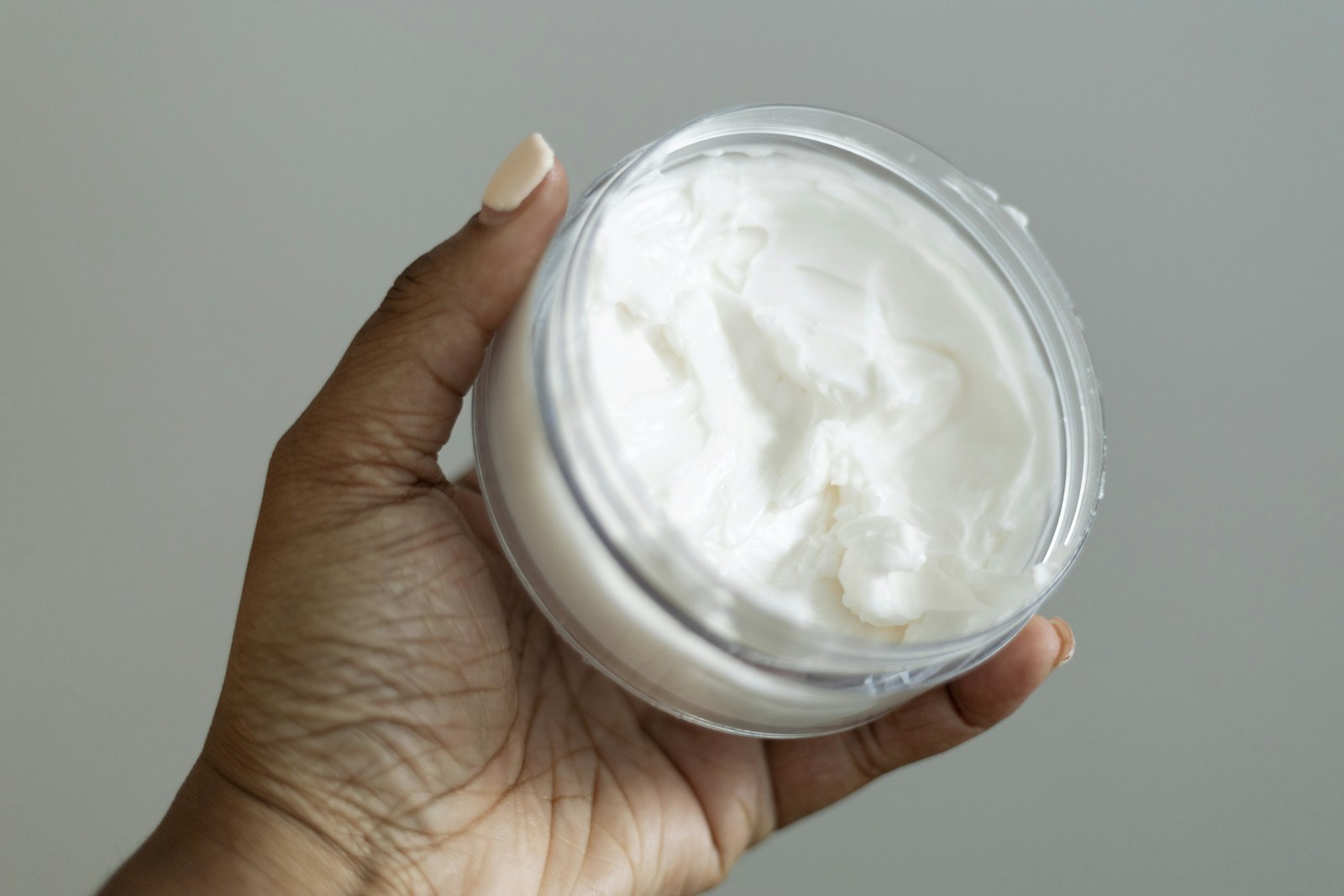
Spoon into clean, dry jars. Tap the jar gently on the counter to settle out air pockets. Cap loosely for the first hour while it stabilizes at room temperature, then seal.
Use a clean dry spoon to scoop product later. Water in the jar is the only real enemy of tallow body butter.
Scaling
This recipe scales cleanly up and down. The ratios are what matter, not the absolute amounts.
For a single 8 oz jar, use 1/3 cup tallow, 2 tbsp + 2 tsp shea, 1 tbsp + 1 tsp coconut oil, 2 tsp jojoba.
For a half-gallon batch (gift season), quadruple everything. You will need a 5-quart stand mixer bowl and a bigger ice bath. The whip time stretches to about 12 minutes.
I do not recommend going larger than a quadruple batch in a home mixer. The fat sloshes too high and you lose half of it down the sides.
Variations
Calm bedtime version. Lavender and Roman chamomile, 15 drops each. I keep a jar of this on my nightstand for nights when my hands have been outside too long.
Citrus morning version. Sweet orange, bergamot, and a single drop of rosemary. 25 drops total. Smells like a cafe and absorbs in about 90 seconds.
Climate-stable summer version. If you live somewhere that hits 95F regularly, the recipe above will go soft and grainy in storage. Bump the shea to 3/4 cup and drop the coconut oil to 2 tablespoons. The higher shea ratio holds structure better at room temperature. I went into more detail on warm-climate texture in the body butter at home guide.
Heavier hand cream version. Sub the jojoba for an extra 2 tablespoons of tallow and you get a thicker product that is closer to a salve. Good for cracked knuckles in February.
For a closer look at how scent choices and base oils interact with tallow, the face cream guide covers the same ratios scaled down for delicate facial skin.
Common Problems
Grainy texture. You cooled too fast or whipped too cold. To fix, gently re-melt the whole batch, cool more carefully this time, and re-whip.
Collapsed back to liquid. You whipped too warm. The fats never crystallized enough to hold air. Same fix as above.
Beefy smell coming through. This happens with cooking-grade tallow that was not rendered carefully. Either re-render at lower temperature with a wet rendering method, or switch to deodorized base like the Traverse Bay 32 oz.
Separation in the jar. Usually water contamination from a wet scoop or a damp jar. Always dry your jars completely before filling and use a dry spoon.
Frequently Asked Questions
How long does this body butter last?
In a sealed jar at room temperature, six months easily. In the fridge, closer to a year. I have never had a batch go rancid, but I also use mine within two months.
Can I skip the shea butter?
You can. The result will be greasier and slower to absorb. If you want a pure tallow body butter without any other plant butter, double the jojoba and add 2 tablespoons of beeswax instead of shea to hold structure.
Will this clog pores on my face?
Tallow itself has a similar fat profile to human sebum and most people use it on their face without issue. This particular recipe includes coconut oil, which is comedogenic for some people. If you are acne-prone, skip the coconut oil and replace it with squalane or more jojoba. The face cream walkthrough and the beef tallow for face guide both cover this in more detail.
Why does my finished butter smell faintly like beef?
Two possibilities. Either you started with cooking-grade tallow that was not deodorized, or you skipped the essential oil and your nose is picking up on what is naturally there. A few drops of lavender or vanilla bean essential oil will mask it entirely. Or use a base like Traverse Bay 32 oz, which has been deodorized at the source.
Can I make this without a stand mixer?
A hand mixer works. It takes a little longer, closer to 12 minutes, and you have to hold it steady. A whisk and your arm can also work but you will be tired and the texture will not be as light.
Bottom Line
The 20-minute version of tallow body butter is the one I make on Saturday mornings when somebody needs a jar by Sunday. It is denser than the cloud-light slow-cool version, but it absorbs cleaner and the jar gets used twice as fast in my house. Start with a quality base like grass-fed tallow, nail the 80F cooling window, and you will have a jar that holds its texture for months.
If this is your first time, halve the recipe and make a single 8 oz jar. Get the timing right at small scale, then go big the next time. The full slow-cool method and a deeper dive on ratios live at /make/body-butter/ whenever you are ready for the cloudier version.