
Beef Tallow vs Vegetable Oil: Why One Is Healthier for Frying
Independent reviewBeef tallow vs vegetable oil for frying. Smoke point reality, oxidation under reuse, the seed oil research, McDonald's pre-1990 history, and a practical verdict.

This post contains affiliate links. We may earn a commission if you purchase through these links, at no extra cost to you.
I get this question almost every week. Is beef tallow actually healthier than vegetable oil for frying, or is it a Twitter trend with a long memory and a short fact-check? The answer is more interesting than either side wants to admit.
Vegetable oils are not poison. Beef tallow is not a miracle. The real comparison sits in the chemistry of what happens when you heat each one, what happens when you heat each one repeatedly, and what your body does with the resulting compounds. I have spent the last few years reading the relevant literature, frying with both, and developing a position I am willing to defend with citations.
Here is the comparison, written for people who want to make a real decision in their own kitchen rather than win an argument online.
The Two Categories
When we say vegetable oil, we usually mean industrial seed oils. The big ones in American kitchens are soybean oil, canola oil, corn oil, sunflower oil, and safflower oil. Cottonseed oil and grapeseed oil round out the list. The unifying feature is that they are extracted from small seeds, usually through a combination of mechanical pressing and chemical solvent extraction, and they are dominated by polyunsaturated fatty acids.
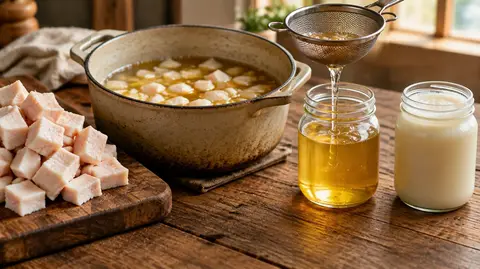
Beef tallow is rendered from the fat tissue of cattle. It is roughly 50% to 55% saturated, 40% to 45% monounsaturated, and only 2% to 5% polyunsaturated. The remainder is trace impurities and a small amount of conjugated linoleic acid.
The difference matters because saturated and polyunsaturated fats behave very differently under heat. Saturated fat is structurally stable. Polyunsaturated fat is structurally unstable.
For the full breakdown across other cooking fats, the tallow vs olive oil piece and the tallow vs avocado oil piece cover the most common alternatives. The compare page for vegetable oil specifically has the cooking-side comparison.
Smoke Point: The Misleading Number
Smoke point is the temperature at which a fat begins to visibly smoke. It is the number most cooking articles lead with. It is also, on its own, a misleading way to evaluate a frying fat.
Refined vegetable oils have respectable smoke points. Soybean oil sits around 450F. Canola oil around 400F. Corn oil around 450F. Sunflower oil around 440F. These numbers are higher than beef tallow, which sits around 400F to 420F depending on how clean the render is.
If smoke point were the only variable, vegetable oils would win. They are not the only variable.
The problem is that smoke point measures the fresh, unused oil. It does not measure what happens after the oil has been heated to frying temperature for an hour, cooled, and reheated for a second batch. Polyunsaturated fats break down under heat. Each break-down cycle lowers the smoke point and increases the volume of oxidized compounds in the fat.
By the third reuse, a typical vegetable oil has a measurably lower smoke point than the day it was opened. By the fifth reuse, the oil is producing visible smoke at temperatures below 400F. Tallow, because it is mostly saturated, holds its smoke point across many more cycles.
The practical version of this. Vegetable oil is a fine fat for one or two fries. Tallow is the fat for ongoing kitchen use where you reuse the same batch across multiple meals. The reuse guide walks through how to make that work with tallow specifically.
What Actually Happens When Polyunsaturated Fats Are Heated
This is the chemistry that the popular debate keeps glossing over.
Polyunsaturated fatty acids have two or more carbon-carbon double bonds in their chain. These double bonds are reactive. When the oil is heated, especially in the presence of oxygen, those double bonds break and recombine into new compounds. The most studied of these compounds is 4-hydroxynonenal, abbreviated 4-HNE. It is an aldehyde, and it is what gives reheated oil its characteristic stale smell.
The research on 4-HNE is not flattering. A 2007 study by the Kasai lab at Kyoto University demonstrated that 4-HNE forms in measurable quantities when polyunsaturated oils are repeatedly heated to frying temperatures. A 2013 review in Food and Chemical Toxicology summarized animal evidence linking 4-HNE exposure to oxidative stress in liver and cardiovascular tissues. A 2010 review by Csallany and colleagues quantified 4-HNE in restaurant frying oils and found concentrations that rose with usage cycles.
This does not mean that one batch of fries cooked in soybean oil will harm you. The dose makes the poison. But the cumulative exposure from a diet built around heavily reheated vegetable oils is one of the more credible mechanisms by which industrial fats might be doing harm.
Saturated fats do not produce 4-HNE at meaningful levels because the chemical structure does not support the same kind of degradation. This is the part of the seed-oil debate that has the strongest research footing.
The Linoleic Acid Question
Beyond the heat-degradation story, there is a separate question about whether the high linoleic acid content of vegetable oils, eaten cold or hot, is itself a problem.
Linoleic acid is an essential fatty acid. The body cannot make it. A small amount is necessary. The American diet has gone from a population intake of about 2% to 3% of calories from linoleic acid in 1900 to roughly 7% to 9% today, almost entirely because of the industrialization of seed oils.
The relevant research here splits into two camps. The 2013 reanalysis of the Sydney Diet Heart Study by Christopher Ramsden and colleagues, published in BMJ, found that men who replaced saturated fat with safflower oil had increased all-cause mortality, increased cardiovascular mortality, and increased coronary heart disease mortality despite lower cholesterol. The 2016 Minnesota Coronary Experiment reanalysis, also by Ramsden’s group, found similar results.
On the other side, the work of researchers like Tom Sanders at King’s College London and the broader meta-analyses commissioned by the American Heart Association continue to support linoleic acid substitution as cardio-protective. The PUFA-replacement consensus has not collapsed, but it has been challenged in ways that did not exist twenty years ago.
You can read the Ramsden papers in BMJ and form your own view. They are not fringe. They are published in a top medical journal and they are the clearest example of the kind of nuance the popular debate keeps missing.
The McDonald’s Pre-1990 History
There is a small piece of culinary history that explains where this debate even came from.
From the founding of McDonald’s in 1955 until 1990, McDonald’s fried its french fries in a mixture of about 93% beef tallow and 7% cottonseed oil. The fries were widely considered the best in the industry. There is a reason older customers will tell you, unprompted, that McDonald’s fries used to taste different. They did.
In 1990, under pressure from the cardiologist Phil Sokolof and his “Poisoning of America” newspaper campaign, McDonald’s switched to vegetable oil. The cited reason was saturated fat content. Sales of the fries did not collapse, but the flavor did change, and the change was permanent.
The switch happened during a period when the saturated-fat consensus was at its peak in American public health. The Surgeon General’s 1988 report had identified saturated fat as a primary dietary culprit in cardiovascular disease. The 1990 USDA guidelines reinforced the recommendation. McDonald’s read the room.
The point is not that McDonald’s fries are health food. They are not. The point is that the switch from tallow to vegetable oil was a public health intervention, made on the assumption that saturated fat was driving heart disease, and that assumption has been rigorously challenged in the literature since. We did not choose vegetable oil because it makes better fries. We chose it because we believed it was safer. That belief is, at minimum, more complicated than it was in 1990.
The tallow in history piece covers the broader story of how American kitchens lost animal fats. It is the context most modern cooking advice forgets.
Side By Side at Home
What does this mean for an actual home cook with a pot of oil and a basket of potatoes?
For one or two fries with a fresh bottle of oil, vegetable oil is fine. The fries will taste neutral. The oil will not have built up oxidized compounds yet. If you are eating fries twice a year, the choice does not matter much.
For ongoing home frying with reuse, tallow is the better choice. The fat holds up across five to eight reuses on low-debris foods, which makes it cheaper per fry and produces less oxidized fat per cycle. The flavor of the fries gets richer over time. Vegetable oil over the same number of reuses degrades visibly and audibly, with a darker color and more foam.
For deep frying tradition (fried chicken, fried fish), tallow gives the most authentic result for American Southern frying and British fish-and-chips. Vegetable oil is the modern default for both, but it is the cheaper substitute, not the original.
If you fry weekly, switch to tallow. If you fry rarely, the choice matters less, but tallow is still my recommendation because the flavor is better and the long-term math on oxidized compound exposure favors saturated fats.
Cost
Vegetable oil is cheaper per ounce. A gallon of restaurant-grade canola oil runs about ten dollars. A pound of beef tallow runs eight to fifteen dollars depending on grade. On a per-fry basis, tallow is two to three times the cost of vegetable oil.
That cost gap closes once you factor in reuse. A pound of tallow reused six times costs roughly the same per fry as a pound of canola oil reused twice. The vegetable oil degrades faster, so you cycle it through more often. The total fat-dollar over a year of frying is closer than the sticker shock suggests.
For the actual buying decision, 100% Pure Grass-Fed Beef Tallow (4 lbs) is what I keep in the pantry as a frying batch. Traverse Bay Farms (32 oz) is the smaller buy if you want to try the fat before committing four pounds.
What I Cook In
I use tallow for everything I fry at home. Fries, chicken wings, onion rings, hash browns, occasional doughnuts. I use a small bottle of avocado oil for high-heat searing where I want a neutral flavor profile, and I use butter for finishing. I do not keep vegetable oil in my kitchen.
This is not because vegetable oil will hurt me in a single use. It will not. It is because tallow tastes better, holds up better to my actual cooking patterns, and aligns with my read of the research on chronic exposure to oxidized polyunsaturated fats.
If you want a different cooking-fat decision tree, the smoke point and temperature guide covers heat-by-application. The healthy fat science piece covers the nutritional case for tallow specifically.
Frequently Asked Questions
Is vegetable oil definitely bad for me?
No. A small amount of fresh vegetable oil in your diet is unlikely to harm you. The concerns are about chronic exposure to repeatedly heated vegetable oils and the high overall intake of linoleic acid in modern Western diets. Once in a while is fine. Daily, across years, in oils that have been heated and reheated, is where the research starts to find real signals.
Is grass-fed tallow better than grain-fed?
For frying purposes, slightly. Grass-fed has a marginally better fatty acid profile, higher conjugated linoleic acid content, and a faintly cleaner flavor. The difference for high-heat cooking is real but small. Grain-fed tallow will still fry better than vegetable oil under the metrics that matter for reuse and oxidation.
What about avocado oil?
Avocado oil is mostly monounsaturated and holds up to heat well. It has a high smoke point and a neutral flavor. It is a reasonable choice for one or two fries, especially if you want a vegetarian high-heat oil. It does not reuse as well as tallow, and it costs more per ounce than either tallow or canola oil. The tallow vs avocado oil comparison covers it in detail.
Does refining vegetable oil remove the heat-degradation problem?
Refining lowers some impurities but does not change the underlying fatty acid composition. A refined polyunsaturated oil will still oxidize under repeated heating. Refining moves the starting line, not the finish line.
Is there a safe way to fry in vegetable oil?
Use it once, dispose of it. Do not reuse beyond a single batch. Strain immediately. Keep the temperature steady, never above 375F. These habits will minimize the oxidation problem. They will not eliminate it.
How does tallow compare to coconut oil for frying?
Both are high in saturated fat. Coconut oil has a higher proportion of medium-chain triglycerides. The smoke point of refined coconut oil is around 400F, similar to tallow. Flavor is very different. For deep frying chicken or fries, tallow wins on flavor and authenticity. For Asian-style stir frying or coconut-forward recipes, coconut oil makes more sense. The tallow vs coconut oil piece goes deeper.
Bottom Line
Vegetable oil is fine for one-off frying with a fresh bottle. Tallow is the better choice for ongoing home frying because it holds up to reuse, produces fewer oxidized compounds, tastes better, and aligns with the most credible read of the long-term nutrition research. The cost gap closes once you factor in reuse cycles.
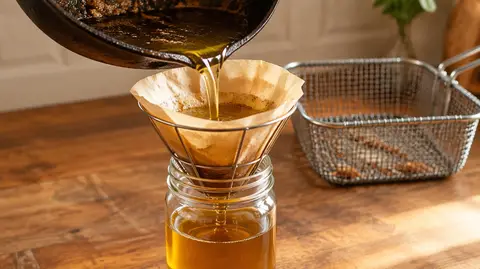
If you fry at home more than once a month, switch to a real frying batch of tallow. Start with the 32 oz Traverse Bay jar or the 4 lb grass-fed tub. Filter after every batch, store in a cool dark spot, and let the same batch carry you through six or eight rounds before you refresh.
Explore more tallow guides
Browse our collection of recipes, comparisons, reviews and DIY tutorials.
View all guidesKing Tallow is reader-supported. We research and test the products we recommend, and when you buy through links on this page we may earn a commission at no extra cost to you. See our affiliate disclosure.
Published